


Yes, an air purifier can help with smell, but only if it has an activated carbon filter. Standard HEPA filters are designed to trap solid particles like dust and pet dander, but they cannot catch gas molecules. An activated carbon filter chemically attracts and traps gaseous odors, effectively neutralizing smells from cooking, pets, and smoke.
Imagine walking through your front door after a long day at work. Instead of the fresh, welcoming scent of home, you are hit with a heavy wave of last night’s fish dinner. Or maybe you smell the distinct, musty odor of a wet dog. We have all been there. Bad smells can sneak up on us and ruin our comfort. You might light a candle or spray an aerosol air freshener. But those solutions only cover up the problem. They do not actually get rid of the odor.
This frustrating issue leads many homeowners to look for a permanent solution. You might ask yourself: does an air purifier help with smell? It seems like the perfect hands-off answer. You just plug it in, turn it on, and let it clean your air. But if you buy the first unit you see on a store shelf, you might end up disappointed.
In this guide, we will dive deep into how air purifiers handle bad odors. We will explain why some models work wonders while others do nothing for smells. You will learn the science behind odors, the specific filters you need, and how to choose the best device for your home. Let us clear the air once and for all.
Key Takeaways
- Activated carbon is essential: Standard HEPA filters do not capture odors because smells are made of tiny gas molecules that pass right through them.
- Adsorption is the key process: Activated carbon traps odors by chemically binding gas molecules to its massive surface area.
- Filter weight matters: Look for purifiers with actual carbon pellets rather than thin, carbon-coated fiber sheets for real odor control.
- Source control is best: Air purifiers work most efficiently when you clean up the source of the smell first.
- Timely replacement: You must change carbon filters every 3 to 6 months because they stop working once their pores are full.
- Avoid ozone generators: Some units release ozone to kill smells, but this gas can harm your lungs and your pets.
📑 Table of Contents
The Science of Smell: Why Some Air Purifiers Fail
To understand how to get rid of smells, we must first look at what smells actually are. Odors are not solid things. They are made of tiny, invisible gas molecules. When your dog runs in from the rain, or when you fry bacon, these gas molecules float into your air.
Particles vs. Gases
Many people confuse air particles with gases. Particles are solid or liquid droplets. This category includes dust, pollen, mold spores, and pet dander. Gases, on the other hand, are free-flowing molecules. Because gases are so tiny, they behave very differently than particles. This physical difference is why a standard air purifier might fail to remove odors from your home.
Why HEPA Filters Alone Aren’t Enough
You have probably heard of HEPA filters. HEPA stands for High-Efficiency Particulate Air. These filters are amazing at catching particles. They can trap 99.97% of dust, pollen, and pet dander. However, they have a major limitation. They cannot stop odors.
HEPA filters are made of a dense web of glass fibers. This web acts like a net. The net is perfect for catching solid particles. But odor molecules are thousands of times smaller than dust. They glide right through a HEPA filter like water through a tennis racket. If your air purifier only has a HEPA filter, it will not help with smell at all.
The Hero of Odor Elimination: Activated Carbon
If HEPA filters cannot stop smells, what can? The answer is activated carbon. This is the secret weapon in the fight against household odors. If you want to know, “does an air purifier help with smell?” you must look for this specific component.
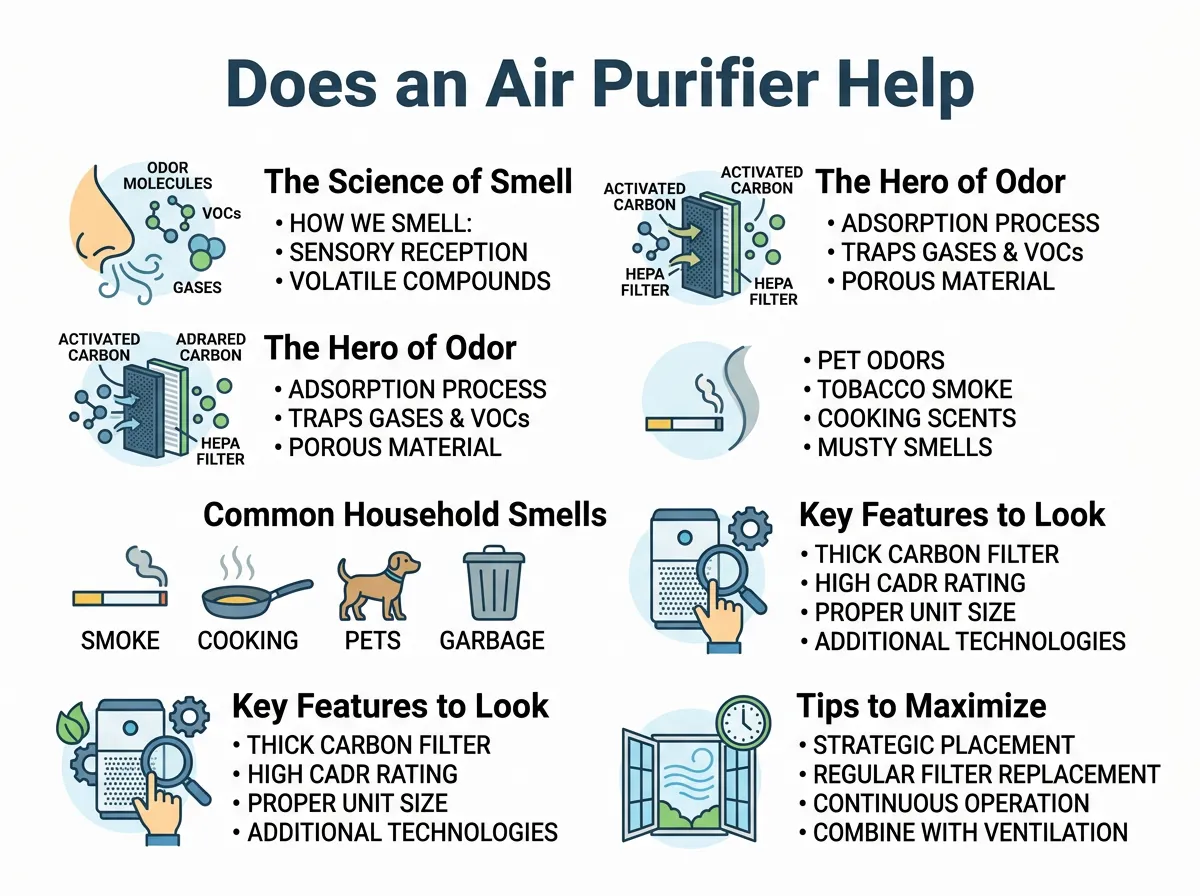
Does an Air Purifier Help With Smell? — key points at a glance
What is Activated Carbon?
Activated carbon is charcoal that has been treated with oxygen. This treatment opens up millions of tiny pores between the carbon atoms. This process increases the surface area of the carbon by an incredible amount. In fact, just one gram of activated carbon can have a surface area of over 10,000 square feet! This massive surface area acts like a giant sponge for gases.
How Adsorption Works
Unlike a kitchen sponge that absorbs water, carbon works through a process called adsorption. Note the “d” in the word. Adsorption means that gas molecules stick to the outside surface of the carbon pores.
When smelly gas molecules pass through the filter, they get trapped in these microscopic pores. They chemically bond to the carbon and cannot escape. This process is backed by scientific research on indoor air quality, which shows that carbon filtration is highly effective at reducing volatile organic compounds (VOCs) and gaseous pollutants from the room.
Common Household Smells and How Purifiers Tackle Them
Now that we know how carbon works, let us look at how it handles common household odors. Different smells have different sources, and a good purifier can tackle them all.
Cooking Odors
We love to cook, but we do not love the lingering smell of fried onions, garlic, or fish. These cooking odors are made of oily, gaseous compounds. An air purifier with a thick carbon filter will pull these greasy molecules out of the air. This keeps your kitchen smelling fresh, even after a heavy cooking session.
Pet Odors
Pets bring joy, but they also bring odors. Cat litter boxes, wet dogs, and small animal cages can quickly make a room smell bad. While HEPA filters catch pet dander and fur, the carbon filter takes care of the ammonia and organic gases that cause pet smells.
Smoke Odors
Whether it is from a burnt dinner, cigarette smoke, or nearby wildfires, smoke is incredibly hard to get rid of. Smoke is a mix of tiny solid particles and toxic gases. To clear smoke, you need a two-stage approach. The HEPA filter stops the visible smoke particles. The carbon filter traps the toxic gases and the strong smell.
Chemical Odors and VOCs
New furniture, fresh paint, and cleaning products release chemicals called Volatile Organic Compounds (VOCs). These gases can cause headaches and throat irritation. According to clinical data on indoor air filtration systems, trapping these harmful chemical gases is vital for maintaining a healthy indoor living space. A high-quality activated carbon filter is the best way to capture these unseen threats.
Key Features to Look For When Buying an Odor-Busting Air Purifier
If you are ready to shop, you need to know how to spot a purifier that actually works on smells. Do not just trust a flashy box that says “removes odors.” Look at the specs.
The Weight of the Carbon Filter
This is the most important tip. Not all carbon filters are created equal. Some cheap purifiers use a thin fiber filter coated in a tiny bit of carbon dust. These look like thin black sponges. They will absorb light odors for a few weeks, but they quickly get saturated.
For real odor control, look for a purifier with a pellet-based carbon filter. These filters contain pounds of actual carbon pellets packed into a honeycomb frame. The heavier the filter, the more odors it can hold, and the longer it will last.
Room Size and Clean Air Delivery Rate (CADR)
An air purifier can only clean the air it can reach. Make sure the unit you buy is rated for your room size. Look for the Clean Air Delivery Rate (CADR). This rating tells you how fast the unit filters the air. If you have a large kitchen, you need a high CADR rating to clear cooking smells quickly.
Avoid Ozone Generators
Some devices claim to destroy odors using ozone. Avoid these. Ozone is a lung irritant that can be harmful to your health, your pets, and your plants. Stick to safe, mechanical filtration like HEPA and activated carbon.
Tips to Maximize Your Air Purifier’s Odor-Eliminating Power
Buying a good purifier is just the first step. To get the best results, you need to use it correctly.
Place It Near the Source
If you want to clear dog smells, put the purifier near the dog bed. If you are cooking, run the purifier in or near the kitchen. Catching the smell at the source before it spreads to the rest of the house is much easier.
Run It on High During Odor Events
Do not wait until the smell fills your house to turn on your purifier. If you are about to fry fish, turn the purifier on high before you even heat up the pan. Let it run for an hour after you finish cooking to clear out any lingering molecules.
Replace Your Filters on Time
Carbon filters have a limit. Once all the microscopic pores are filled with gas molecules, the filter is full. It cannot hold any more smells. In fact, an old carbon filter might start releasing bad smells back into the room. Check your manual and change your carbon filter every 3 to 6 months for best results.
Conclusion
So, does an air purifier help with smell? Yes, it absolutely does, but only if you choose the right one. Remember, a HEPA filter alone is not enough for gases and odors. You must have a strong, heavy activated carbon filter to trap the invisible gas molecules that cause bad smells.
By choosing a high-quality purifier, placing it in the right spot, and changing the filters regularly, you can enjoy a fresh, clean-smelling home every single day. No more hiding bad odors with perfumes. It is time to clear them out for good.
Frequently Asked Questions
Does a HEPA filter remove smells?
No, a standard HEPA filter cannot remove smells because odors are made of tiny gas molecules. HEPA filters are only designed to trap solid particles like dust, pollen, and pet dander. To remove smells, you need an air purifier that also includes an activated carbon filter.
How long does it take for an air purifier to get rid of a smell?
In a standard-sized room, a properly rated air purifier can significantly reduce smells within 30 to 60 minutes. For very strong odors like burnt food or heavy cigarette smoke, it may take several hours of running the unit on high to completely clear the air.
Can an air purifier help with dog and cat smells?
Yes, an air purifier with a thick activated carbon filter is highly effective at neutralizing pet smells. It can capture the organic compounds and gases that cause litter box odors, wet dog smells, and general pet odors. The HEPA filter will also capture the dander and fur that contribute to the smell.
Why does my air purifier smell bad?
If your air purifier is releasing a bad smell, it usually means the filters are dirty and need to be replaced. When an activated carbon filter becomes completely saturated with gas molecules, it can no longer hold them and may start releasing the trapped odors back into your room.
Do air purifiers help with cigarette smoke smell?
Yes, but you need a heavy-duty air purifier with both a True HEPA filter and a thick activated carbon filter. The HEPA filter will capture the visible smoke particles, while the carbon filter will adsorb the toxic gases and strong chemical odors associated with cigarette smoke.
Can I wash my carbon filter to remove the smell?
No, you should never wash an activated carbon filter. Water will ruin the porous structure of the carbon and make it completely useless for trapping odors. Once a carbon filter is saturated and starts to smell, you must replace it with a new one.
