


Yes, an air purifier can help with mold, but only by capturing airborne mold spores before they land and grow. It cannot resolve an active dampness issue or remove existing mold patches from walls. To prevent mold growth, you must combine a True HEPA air purifier with moisture control and physical cleaning.
Imagine walking into your home after a long day and noticing a faint, musty smell. You look around the living room and hallway, but you do not see anything out of the ordinary. Still, you find yourself sneezing, coughing, or dealing with itchy eyes more than usual. Indoor air quality can be incredibly tricky to manage, especially when invisible particles are floating all around us. If you suspect there are microscopic invaders hiding in your living space, you might find yourself asking a very common question: Does an Air Purifier Help With Mold?
Dealing with mold can feel like an uphill battle. It seems to appear out of nowhere, clinging to walls, ceilings, and damp corners. Many homeowners turn to technology to help them clean up their air and protect their health. But before you spend your hard-earned money on a new gadget, it is important to understand what these machines can actually do. Are they a magic shield against fungal growth, or are they just a small part of a much bigger puzzle?
In this guide, we will explore the science behind how mold spreads throughout your home. We will also discuss how modern filtration systems work to capture these microscopic threats. Finally, we will share practical tips on how to combine air filtration with other home maintenance habits. By the end of this article, you will have a clear, step-by-step plan to keep your indoor air fresh, clean, and completely free of mold spores.
Key Takeaways
- HEPA Filters Are Essential: Only True HEPA filters can capture tiny airborne mold spores.
- Purifiers Do Not Kill Existing Mold: They prevent new growth but cannot clean mold off walls.
- Moisture Control Is Vital: You must fix leaks and lower humidity to stop mold permanently.
- Activated Carbon Helps With Odors: Carbon filters absorb the musty smell caused by mold.
- Run the Device Continuously: Keep your air purifier running 24/7 on low for constant protection.
- Replace Filters Regularly: Clogged filters lose efficiency and can harbor mold if they get damp.
📑 Table of Contents
Understanding Mold and How It Spreads
To understand how to fight mold, we first need to know what we are up against. Mold is a type of fungus that plays an important role in nature by breaking down organic matter. However, when it moves indoors, it becomes a major problem. Mold releases microscopic seeds called spores into the air. These spores are incredibly small, often measuring between 2 and 100 microns in size. For comparison, a single human hair is about 70 microns wide.
Because they are so light, these spores can float through the air for long periods. They drift from room to room, looking for a hospitable place to land. You can learn more about how mold spores travel through indoor air to understand how easily they spread. If a spore lands on a damp surface with a food source, like drywall, wood, or carpet, it will begin to grow. Within 24 to 48 hours, a single spore can turn into a thriving colony. This rapid growth is why keeping the air clean is so critical.
How Air Purifiers Handle Mold Spores
When asking ourselves, Does an Air Purifier Help With Mold?, we have to look closely at how these devices process the air. An air purifier works by pulling the air from your room through a series of filters. These filters trap airborne particles, and then the machine pushes the clean air back into the room. This continuous cycle keeps the air in your home moving and free of contaminants.
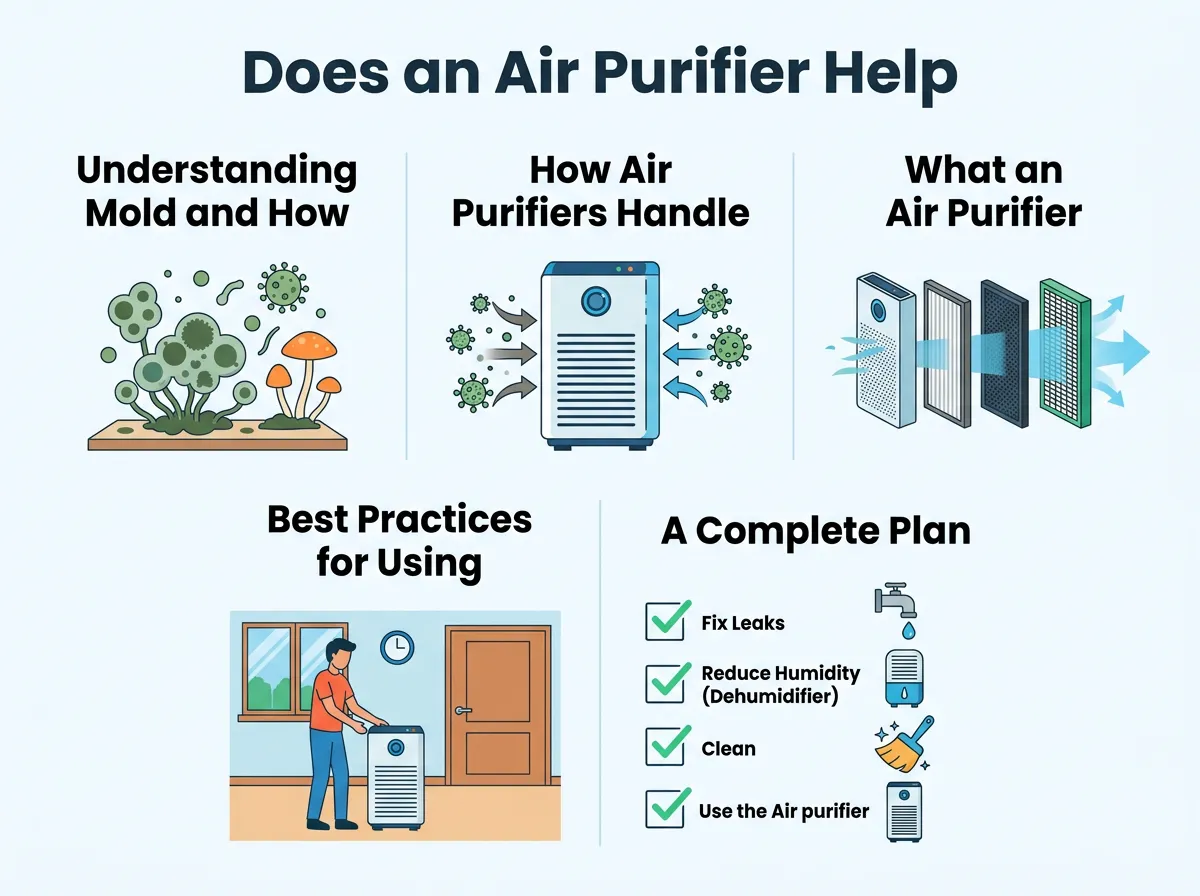
Does an Air Purifier Help With Mold? — key points at a glance
It is important to know that an air purifier does not search for mold on your walls. Instead, it acts as a passive net. It catches the floating spores before they have a chance to land and start a new colony. According to scientific research on HEPA filters and mold, these systems are highly effective at capturing airborne biological particles, reducing the overall concentration of spores in closed spaces.
The Power of True HEPA Filters
Not all air filters are created equal. If you want to trap mold spores, you must look for a device with a True HEPA filter. HEPA stands for High-Efficiency Particulate Air. A True HEPA filter is rated to capture 99.97% of particles that are as small as 0.3 microns. Because almost all mold spores are much larger than 0.3 microns, a True HEPA filter will easily trap them. When a spore gets pulled into the filter, it becomes physically stuck in the dense maze of fibers and cannot escape.
What About Activated Carbon and UV Light?
While a HEPA filter traps the physical spores, mold also creates other issues, like musty odors. This is where an activated carbon filter comes in handy. Carbon filters contain tiny pores that absorb gas molecules, odors, and volatile organic compounds (VOCs). If your basement or bathroom has that classic moldy smell, a carbon filter will help neutralize the odor.
Additionally, some purifiers feature ultraviolet (UV) light technology. The UV light shines on the filter to destroy the DNA of trapped mold spores and bacteria, rendering them harmless. While not strictly necessary if you change your filters regularly, UV light can add an extra layer of peace of mind.
What an Air Purifier Can and Cannot Do
To truly answer the question, Does an Air Purifier Help With Mold?, we must establish clear boundaries. These machines are incredibly useful, but they are not magic. Knowing their limitations will save you time, money, and frustration.
What It Can Do
- Trap Airborne Spores: It removes floating mold spores from the air, preventing them from spreading to new areas.
- Reduce Allergy Symptoms: By lowering the number of spores you inhale, it can relieve sneezing, coughing, and runny noses.
- Eliminate Mold Odors: Units with carbon filters can successfully remove musty smells.
- Keep Air Circulating: Constant airflow prevents stagnant pockets of air where mold loves to grow.
What It Cannot Do
- Kill Existing Mold: An air purifier cannot remove mold that is already growing on your walls, baseboards, or furniture.
- Lower Indoor Humidity: It does not remove moisture from the air. High humidity will still allow new mold to grow.
- Fix the Root Cause: It cannot fix a leaky pipe, a dripping roof, or a damp basement floor.
When you are choosing the right device for mold prevention, keep these limits in mind. An air purifier is a preventative tool, not a remediation cure.
Best Practices for Using Your Purifier Against Mold
To get the most out of your air purifier, you need to use it correctly. Simply plugging it in and walking away is not always enough. Here are some simple, practical tips to maximize its effectiveness.
Choose the Right Location
Place your air purifier in the room where you suspect mold is most likely to grow. Basements, bathrooms, kitchens, and laundry rooms are common trouble spots. Make sure the unit is placed in an open area. Do not hide it behind a couch or tuck it into a tight corner. It needs plenty of space around it to draw in air from all directions.
Run the Device Continuously
Mold spores do not take breaks, and neither should your purifier. To keep the air clean, run your device 24 hours a day, 7 days a week. Most modern air purifiers are designed to be energy-efficient. Running them on a low or auto setting will not spike your electricity bill, but it will keep your air consistently clean.
Perform Regular Filter Maintenance
As your purifier traps mold spores, the filter will slowly clog up. If you do not change the filter, the machine will have to work harder, and its efficiency will drop. Always follow the manufacturer’s guidelines for filter replacement. When changing a dirty filter, wear a mask and do it outside or near a trash can to avoid breathing in any dislodged spores.
A Complete Plan to Eradicate Mold
If you are still wondering, Does an Air Purifier Help With Mold?, the answer is yes, but only as part of a larger plan. To truly get rid of mold, you must take a multi-step approach that addresses both the air and the physical surfaces of your home.
Step 1: Locate and Fix the Moisture Source
Mold cannot survive without moisture. If you have a leak, fix it immediately. If your home has high humidity, use a dehumidifier to keep the relative humidity levels below 50%. This creates a dry environment where mold spores cannot grow, even if they land on a surface.
Step 2: Clean Existing Mold Safely
If you see physical mold growing on a hard surface, you must scrub it off. Use a mixture of water and mild detergent, or a specialized mold cleaner. For porous materials like drywall or ceiling tiles, you may need to cut out and replace the damaged sections entirely. Always wear protective gear, including gloves and a mask, while cleaning.
Step 3: Run Your Air Purifier to Clean Up the Air
Cleaning physical mold will naturally stir up millions of spores into the air. This is the perfect time to run your air purifier on its highest setting. It will capture the newly airborne spores before they can settle elsewhere in your home, preventing the infestation from starting all over again.
Conclusion
So, Does an Air Purifier Help With Mold? Absolutely. When equipped with a True HEPA filter, an air purifier is an incredibly powerful tool for trapping airborne mold spores and improving your indoor air quality. It helps protect your health, reduces allergy symptoms, and keeps spores from spreading to new corners of your home.
However, an air purifier cannot do the job alone. It must be paired with active moisture control and physical cleaning. By fixing leaks, keeping humidity low, and running a high-quality air purifier, you can create a dry, clean, and healthy environment. Take action today, protect your home, and enjoy the peace of mind that comes with breathing clean air.
Frequently Asked Questions
Does an air purifier kill mold?
No, an air purifier does not kill mold. It physically traps airborne mold spores inside its filter, preventing them from floating around your home. To kill mold, you must physically clean it with appropriate cleaning solutions.
Can mold grow inside an air purifier filter?
Yes, mold can grow inside the filter if the air purifier is placed in a very humid environment or turned off for long periods. To prevent this, run your purifier continuously and replace your filters regularly according to the manual.
What type of air purifier filter is best for mold?
A True HEPA filter is the best option because it can capture 99.97% of microscopic particles as small as 0.3 microns. You should also look for a unit with an activated carbon filter to help absorb musty mold odors.
How long should I run my air purifier to clear mold spores?
You should run your air purifier 24 hours a day, 7 days a week. Running it continuously ensures that any new spores released into the air are captured immediately before they can land and colonize surfaces.
Will an air purifier help with musty mold smells?
Yes, an air purifier can help with musty smells, but only if it contains an activated carbon filter. While HEPA filters trap physical particles, carbon filters specifically absorb the gases and odors associated with mold.
Can a dehumidifier replace an air purifier for mold control?
No, they serve different purposes. A dehumidifier removes moisture from the air to stop mold from growing, while an air purifier removes floating mold spores from the air. For the best results, you should use both devices together.
