


Air purifiers work by drawing in dirty indoor air, passing it through a series of specialized filters to capture airborne particles and gases, and releasing clean air back into your room. By trapping pollutants like dust, pollen, pet dander, and smoke, these handy devices help you breathe much easier every single day.
Imagine sitting on your couch on a warm, sunny afternoon. You look at a beam of light streaming through the window. What do you see? Hundreds of tiny, glowing dust motes floating around in the air. It is a bit shocking to realize that this is the very air we breathe every day. We spend most of our lives indoors, yet indoor air can be much dirtier than the air outside. That is why so many of us turn to those neat little machines humming quietly in the corner.
But what exactly is going on inside those sleek plastic boxes? You might find yourself asking: how does an air purifier work to make our homes feel fresh and clean? It seems almost like magic, but the real process relies on simple science and clever engineering. In this guide, we will take a friendly, easy journey into the inner workings of these home saviors.
We will break down how they capture tiny pests, clean up bad odors, and help you breathe a whole lot easier. Whether you want to escape seasonal allergies or just want a fresher home, understanding how these devices work will help you get the absolute most out of them. Let us dive in!
Key Takeaways
- Multi-stage filtration: Most units use a pre-filter, a HEPA filter, and an activated carbon filter to catch different sizes and types of pollutants.
- HEPA standard: High-Efficiency Particulate Air (HEPA) filters are the gold standard, capturing 99.97% of tiny particles as small as 0.3 microns.
- Carbon for odors: While HEPA filters trap dust and pollen, activated carbon filters are needed to absorb gases, smoke, and household smells.
- CADR matters: The Clean Air Delivery Rate (CADR) tells you how fast the purifier cleans the air in a specific room size.
- Easy maintenance: Regular filter replacement is crucial to keep your air purifier running efficiently and safely over time.
📑 Table of Contents
The Core Mechanism: Pull, Trap, and Release
At its heart, an air purifier is actually a very simple machine. It does not use any complex spells to clean your room. Instead, it relies on a basic three-step process: pulling air in, trapping the bad stuff, and releasing the clean air back to you. If you want to dive deeper into the basic mechanics of this process, you can learn more about how air purifiers work in detail.
Think of it like a giant lung for your living room. First, a motorized fan spins inside the unit. This fan acts like a vacuum cleaner, drawing the air from your room into the machine. Once inside, the air has to pass through a series of dense barriers. These barriers are the filters. Finally, after the air has been stripped of its dirty particles, the fan pushes the freshly cleaned air back out into the room. This continuous cycle keeps the air in your room constantly moving and cleaning itself.
The Role of the Fan
The fan is the unsung hero of the whole setup. Without it, the filters would just sit there. The fan needs to be strong enough to pull air from the far corners of your room. Yet, it also needs to be quiet enough so you can sleep or watch television without a loud roar in the background. Most modern purifiers have different speed settings so you can control this airflow.
Continuous Airflow
For an air purifier to do its job well, it needs to run constantly. As we live our lives, we constantly create new dust, shed skin flakes, and bring in outdoor pollen. By keeping the fan running, the purifier creates a steady loop of clean air. This ensures that new pollutants are caught soon after they land in the air.
The Filter Lineup: A Multi-Stage Defense
When looking at how does an air purifier work, we must talk about filters. Most high-quality units do not rely on just one single filter. Instead, they use a team of filters working together. Each filter has a specific job to do. By understanding different types of filtration technology, you can see how they create a complete shield for your home.
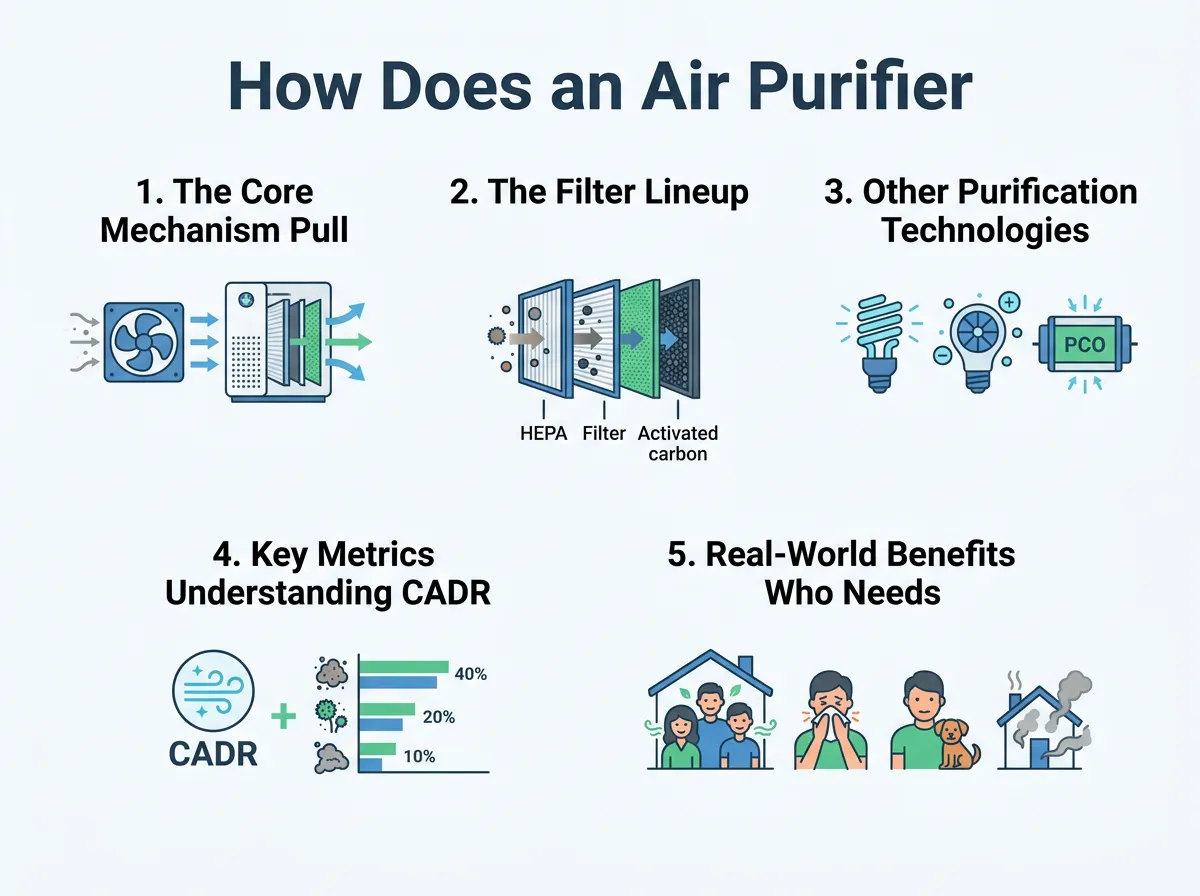
How Does an Air Purifier Work? — key points at a glance
The Pre-Filter: Catching the Big Stuff
The pre-filter is the first line of defense. It is usually made of a simple mesh or foam material. Its job is to catch the large particles that you can easily see with your eyes. This includes things like pet hair, large dust bunnies, and human hair. By catching these big pieces first, the pre-filter stops the inner, more expensive filters from getting clogged up too quickly.
The HEPA Filter: The Heavy Lifter
Next comes the star of the show: the HEPA filter. HEPA stands for High-Efficiency Particulate Air. This filter is made of a dense maze of tiny glass fibers. It is designed to trap microscopic particles that are invisible to the human eye. A true HEPA filter can trap 99.97% of particles that are as small as 0.3 microns. To give you some context, a single strand of human hair is about 70 microns wide. That means a HEPA filter can easily trap pollen, mold spores, dust mites, and even some bacteria!
The Activated Carbon Filter: Neutralizing Odors
While HEPA filters are amazing at catching solid particles, they cannot stop gases, fumes, or bad smells. That is where the activated carbon filter comes in. This filter contains charcoal that has been treated with heat to make it highly porous. These tiny pores act like chemical magnets. They trap gases, smoke, cooking odors, and volatile organic compounds (VOCs) from household cleaners. If you want a fresh-smelling kitchen or want to clear out pet odors, this filter is essential.
Other Purification Technologies (And What to Avoid)
While mechanical filters are the safest and most common, some air purifiers use other technologies to clean the air. It is helpful to know how these work so you can make a smart choice for your home.
UV-C Light Purifiers
Some units feature a built-in ultraviolet (UV) light. As air passes through the machine, it is exposed to this light. UV-C light is designed to destroy the DNA of biological pathogens like viruses, bacteria, and mold spores. This sanitizes the air as it moves through. However, the air must stay under the light long enough for it to work, so it is usually used alongside a standard HEPA filter.
Ionizers
Ionizers work by releasing tiny, electrically charged molecules called ions into the air. These ions attach themselves to airborne dust and pollen particles. This makes the particles heavy, causing them to fall out of the air and land on your floor, walls, or furniture. While this does clear the air, you will still need to vacuum or dust your surfaces to get rid of the fallen dirt.
A Warning About Ozone Generators
Some older or industrial devices produce ozone to clean the air. Ozone can react with pollutants and neutralize them, but it is also a known lung irritant. Breathing in ozone can cause coughing, chest pain, and shortness of breath. For home use, it is always safest to stick with mechanical HEPA and carbon filters that do not produce ozone.
Key Metrics: Understanding CADR and Room Size
To really understand how does an air purifier work in your specific home, you need to look at how much air it can clean. This is where ratings like CADR come into play. Buying a purifier that is too small for your room means the air will not get clean. Buying one that is too big might just waste electricity.
What is CADR?
CADR stands for Clean Air Delivery Rate. This number measures how quickly the purifier can filter out three specific pollutants: smoke, dust, and pollen. The higher the CADR number, the faster the unit cleans the air. For example, a unit with a smoke CADR of 200 will clean the air much faster than one with a CADR of 80.
Matching the Room Size
When shopping, always check the manufacturer’s suggested room size. This is usually based on how many times the machine can clean all the air in the room in one hour. Ideally, you want a machine that can perform about four to five air changes per hour. This ensures that the air stays fresh even if you are cooking or if pets are running around.
Real-World Benefits: Who Needs an Air Purifier?
Now that you know how the machine operates, you might wonder if you actually need one in your home. When people ask how does an air purifier work, they often want to know how it will improve their daily lives. If you are curious about health impacts, reading about whether do air purifiers work for health issues can be highly eye-opening.
Allergy and Asthma Relief
If you suffer from seasonal allergies, you know how miserable pollen can make you feel. An air purifier with a HEPA filter acts like a protective shield. It traps pollen, dust mites, and mold spores before they can reach your nose and lungs. This can lead to less sneezing, fewer stuffy noses, and a much better night of sleep.
Pet Owners
We love our furry friends, but they bring a lot of extra debris into our homes. Between pet dander, loose fur, and outdoor dirt, our air can quickly become heavy. An air purifier helps to collect these pet allergens constantly. It also tackles the distinct odors that sometimes come with dogs and litter boxes.
City Dwellers and Smoke Protection
If you live near a busy road, city smog and exhaust fumes can easily seep into your home. Likewise, wildfire smoke has become a common problem for many areas. A purifier equipped with a heavy-duty activated carbon filter is excellent for capturing these fine smoke particles and harmful chemical gases, keeping your indoor sanctuary safe.
Quick Tips for Getting the Most Out of Your Purifier
To wrap up, let us look at some simple ways to make sure your machine runs at peak performance. Even the best purifier needs a little help to do its job well.
- Find the right spot: Place your purifier in an open area. Do not hide it behind a couch or stick it in a tight corner. It needs space around it to pull in and push out air easily.
- Keep windows closed: When the purifier is running, try to keep your windows and doors shut. Otherwise, you are trying to clean the air of the whole neighborhood!
- Run it continuously: Do not just turn it on for an hour and turn it off. Keep it on a low, quiet setting all day and night for steady clean air.
- Replace filters on time: Over time, filters get filled with dirt and cannot hold any more. Check the manual and change them as recommended to keep the unit running efficiently.
Conclusion
At the end of the day, understanding how does an air purifier work helps us appreciate these simple yet effective devices. By combining a powerful fan with a smart mix of pre-filters, HEPA filters, and activated carbon, these machines create a clean-air loop that protects our health. They turn our homes into comfortable havens where we can breathe deeply and relax. By choosing the right size and keeping up with basic filter changes, you can enjoy crisp, fresh air all year round.
Frequently Asked Questions
How often should I replace the filters in my air purifier?
It depends on the model and how often you run it. Generally, pre-filters can be cleaned or replaced every few months, while HEPA filters last 6 to 12 months, and carbon filters last 3 to 6 months.
Can I leave my air purifier on all night?
Yes, it is perfectly safe and highly recommended to leave your air purifier on all night. Most units have a whisper-quiet sleep mode that cleans the air without disturbing your rest.
Do air purifiers remove odors?
Yes, but only if they have an activated carbon filter. While HEPA filters are great for trapping physical dust particles, carbon filters are specifically designed to absorb gases, smoke, and cooking smells.
Where is the best place to put an air purifier?
You should place it in the room where you spend the most time, such as your bedroom or living room. Ensure it is placed in an open area with a few feet of clearance on all sides for optimal airflow.
Do air purifiers help with dust?
Yes, air purifiers are highly effective at reducing dust. The pre-filter catches large dust clumps, while the HEPA filter traps tiny, microscopic dust particles before they can settle on your furniture.
Do air purifiers cool the room down?
No, air purifiers do not cool the air like an air conditioner. They only circulate and clean the existing air in the room, though the gentle breeze from the fan might make you feel slightly cooler.
