



An ionizer cleans the air by releasing negatively charged ions that attach to tiny airborne particles like dust, pollen, and smoke. This extra charge causes the particles to clump together and fall to the ground or stick to nearby surfaces, removing them from the air you breathe. Many modern air purifiers use this technology to create a fresher, cleaner indoor environment.
Do you ever look at a beam of sunlight streaming through your window? If you do, you might see thousands of tiny dust specks floating around. It can feel a bit unsettling to know we breathe those tiny specks in every single day. Our indoor air can hold a lot of these hidden pests. These include pollen, pet dander, mold, and wild smoke particles. We all want to breathe clean, fresh air in our homes. Because of this, many people search for ways to clear out their rooms. That is where modern air purifiers come into play. But one tool stands out from the rest of the pack. It is called an air ionizer.
You might have seen these devices online or in home appliance stores. They promise to clear the air using a very special process. But how do they actually do this? It is easy to feel confused by all the science talk. You might wonder if they are truly safe for your family or if they are just a gimmick. In this guide, we will unpack how these units work in plain, simple language. We will look at their benefits, their downsides, and how they compare to normal filters.
By the end of this guide, you will know exactly what to look for when shopping. We will help you decide if this tool is right for your unique home space. Let us dive in and explore the science of clean air in a simple, friendly way.
Key Takeaways
- Electrical Charging: Ionizers release negative ions that attach to airborne particles to give them a physical charge.
- Particle Clumping: Charged particles clump together, making them too heavy to float in the air.
- Surface Settlement: The heavy clumps fall to the floor or stick to walls, requiring regular dusting and vacuuming.
- Ozone Precautions: Some ionizers can produce small amounts of ozone, so it is vital to choose certified safe models.
- No Filter Costs: Many models use washable plates instead of paper filters, saving you money over time.
- Quiet Operation: Since many units do not rely on large fans, they run much quieter than standard HEPA filters.
📑 Table of Contents
What Does a Ionizer Do? Understanding the Basics
To understand this tool, we must look at how it works on a tiny level. Our air is full of tiny floating things. We call these things particles. They are very light, so they float in the air for a long time. So, what does a ionizer do to help us? In simple terms, it changes the electrical charge of these floating particles.
Most floating dust has a neutral charge. An ionizer uses electricity to create negative ions. Ions are simply molecules with an extra charge. The machine sends these negative ions out into your room. Once they are in the air, they look for things to cling to. They find dust, pollen, and mold spores. When a negative ion touches a piece of dust, it transfers its charge. Now, that piece of dust has a negative charge too.
Why does this matter? It matters because opposite charges attract. But in this case, like-charged particles also start to clump together. The heavy clumps can no longer float. They fall out of the air and land on the ground. According to Healthline’s guide on ionizer benefits, this process helps clear the air of tiny particles that standard filters might miss.
How Does an Ionizer Work?
Let us look deeper into the science behind this tool. It sounds like magic, but it is just basic physics that you can easily understand.
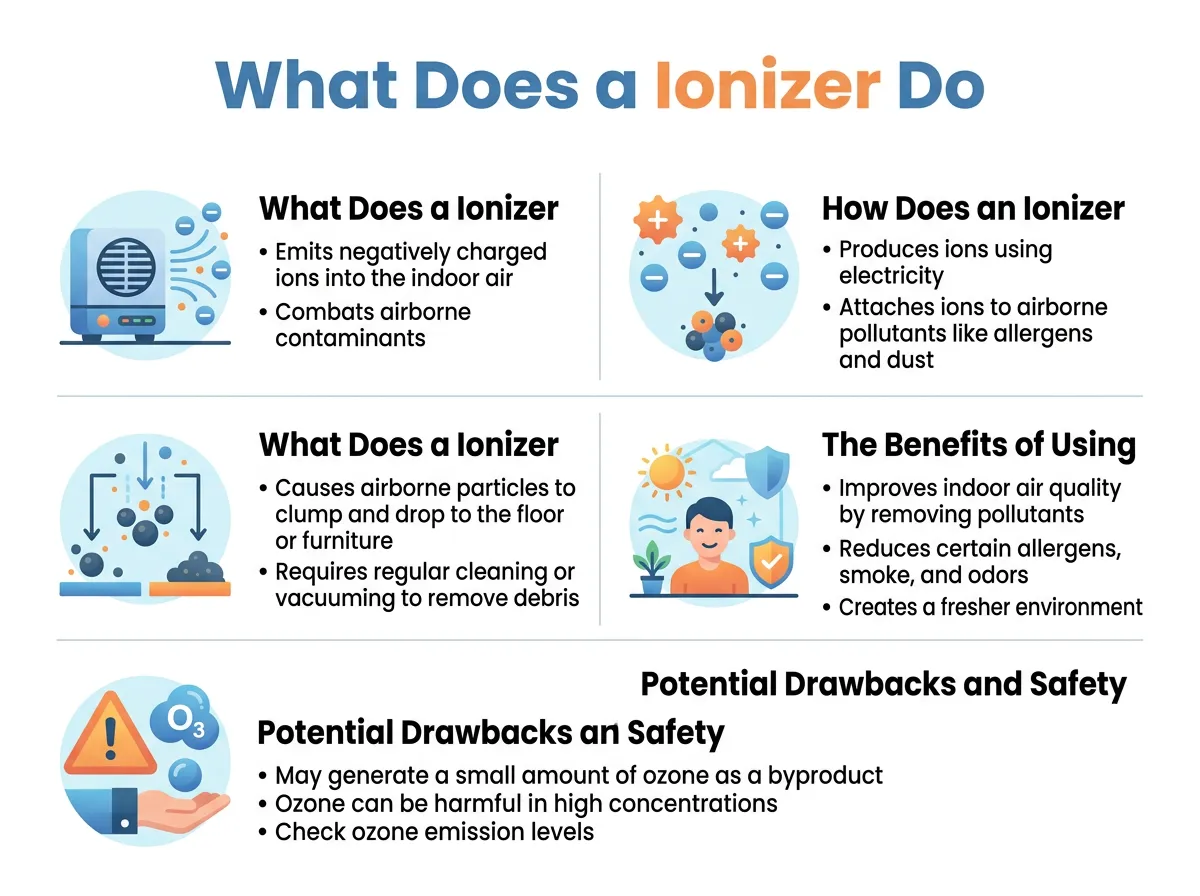
What Does a Ionizer Do? — key points at a glance
The Science of Electrical Charges
Inside the machine, there is a tiny needle or a metal wire. The machine runs electricity through this part. This process creates an electrical field. This field pushes extra electrons out into the room. These electrons quickly join with oxygen molecules. This step creates negative oxygen ions. These ions are highly active. They want to bind with other things in your room as fast as possible.
What Happens to the Clumped Particles?
Once the ions attach to dust, a few things happen. First, the particles get heavy. They can no longer float in the breeze. They sink to the floor, your walls, or your tables. You might notice a thin layer of dust on your desk after running the machine. This is actually a sign that the machine is doing its job. The dust is no longer in your lungs. Instead, it is on a flat surface where you can easily wipe it away.
Some ionizers have built-in collection plates. These plates have a positive charge. Since the dust now has a negative charge, it flies straight to the positive plate. This keeps your walls and floors clean. You just have to wash the plate every few weeks to keep it working well.
What Does a Ionizer Do in Your Home?
Now you know how the physics works. But how does this help your daily life? What does a ionizer do for your home environment? Let us look at the practical jobs this device performs in your living space.
Removing Airborne Dust and Allergens
If you suffer from allergies, spring can be a tough time. Pollen gets into your house every time you open a door. Dust mites live in carpets and beds. Pet dander floats around if you have a dog or cat. What does a ionizer do for these allergens? It targets them directly. By clumping them together, it pulls them out of your breathing zone. This can help reduce sneezing, coughing, and itchy eyes.
Fighting Unpleasant Smells and Smoke
Smells are made of tiny chemical compounds. Smoke from cooking or wildfires is made of very fine particles. These particles are so small they can easily pass through basic mesh filters. An ionizer works well here. It charges these tiny scent particles. Once charged, they fall to the ground. This helps clear out stubborn odors from cooking, pets, or tobacco smoke.
The Benefits of Using an Ionizer
There are many reasons why people love these devices. They offer unique perks that other air cleaners cannot match.
Cleaner Air with Less Noise
Most standard air cleaners use a big fan. This fan forces air through a thick paper filter. This can make a lot of noise. It can sound like a loud hum in your bedroom. Many ionizers do not need a big fan. They use electrical fields to move the air. This means they can run in complete silence. You can sleep soundly while the machine cleans your room.
No Expensive Filters to Replace
Standard air purifiers require new filters every few months. These filters can be very expensive. Over a year, you might spend a lot of money on parts. Many ionizers do not use paper filters. Instead, they use metal plates that you can wash. You just slide the plate out, rinse it in the sink, let it dry, and slide it back in. This saves you money over time.
Potential Drawbacks and Safety Concerns
While these tools are helpful, they are not perfect. It is important to know the potential risks before you buy one for your family.
The Question of Ozone Production
This is the biggest safety concern with ionizers. The high-voltage electricity used to make ions can also split oxygen molecules. This can create ozone gas. Ozone is made of three oxygen atoms. While ozone is good high up in the sky, it is bad to breathe indoors. It can irritate your throat and lungs. It can make asthma symptoms worse. The EPA guidelines on ozone-generating air cleaners warn that even small amounts of ozone can be harmful over time. You should always check the ozone output of any device you buy.
Settled Dust on Your Furniture
If your device does not have a collection plate, the dust has to go somewhere. It will land on your floor, walls, and tables. This can create a dark film on nearby surfaces. This is sometimes called the “black wall effect.” You will need to dust and vacuum your room more often to keep it clean. For safety tips, you can read the safety review of ionizers by IQAir to learn how to avoid these common issues.
How to Choose and Use an Ionizer Safely
If you want to try one of these devices, you must be smart about it. Here are some simple tips to keep your home safe and clean.
Look for Ozone-Free Certifications
When shopping, look for safety labels. In California, the Air Resources Board (CARB) tests air cleaners. They certify devices that emit very low levels of ozone. Look for a CARB-certified label on the box. This ensures the device is safe to use in your home.
Regular Cleaning and Maintenance Tips
To keep your machine working well, clean it often. If your unit has a metal collection plate, wipe it down once a week. If you notice dust building up on the walls near the unit, move it away from the wall. Place it on a hard table that is easy to wipe clean. Never run an ionizer in a tiny, closed room without some airflow.
Conclusion
So, what does a ionizer do? It uses the power of static electricity to clear your indoor air. By turning floating dust into heavy clumps, it helps keep your lungs clear. It works quietly and can save you money on replacement filters. However, you must watch out for ozone levels. By choosing a certified, safe model and cleaning it regularly, you can enjoy fresh, crisp air every single day.
Frequently Asked Questions
Do ionizers remove mold from the air?
Yes, ionizers can help remove mold spores from the air by charging them and making them clump together. Once they clump, they fall to the ground or stick to a collection plate. However, they do not kill the mold on walls or surfaces, so you must still clean up the source of the mold.
Can I leave an ionizer on all day?
You can leave an ionizer on all day if it is a certified low-ozone or ozone-free model. It is best to run it in a well-ventilated room to prevent any buildup of charged particles. If you feel any throat irritation, you should turn it off and open a window.
Is an ionizer the same as a HEPA filter?
No, they are different technologies. A HEPA filter uses a fan to pull air through a fine paper mesh to trap particles, while an ionizer uses electrical charges to make particles clump and fall out of the air. Many modern air purifiers combine both technologies for the best results.
Do ionizers make you cough?
If an ionizer produces too much ozone, it can irritate your airways and cause you to cough. To prevent this, always purchase a CARB-certified model that limits ozone emission. People with asthma should be especially careful when using these devices.
Do ionizers remove bad smells?
Yes, ionizers are highly effective at reducing bad smells from cooking, pets, and smoke. The negative ions attach to the tiny odor molecules and pull them out of the air. This helps refresh the room quickly without using artificial sprays.
How do I know if my ionizer is producing ozone?
You can often tell if your device is producing ozone if you notice a sweet, metallic smell in the room. This is sometimes described as a “clean” or “after-rain” smell, but it is actually the scent of ozone gas. If the smell is strong, you should turn the unit down or off.
