


An air ioniser releases negatively charged ions into the air to attach to positively charged airborne particles like dust, pollen, and smoke. This bond makes the particles too heavy to remain afloat, causing them to fall to the ground or stick to nearby surfaces where they can be cleaned up. By pulling these irritants out of the air, an ioniser helps create a cleaner and healthier indoor breathing environment.
Imagine walking into a room and instantly feeling like you are breathing fresh mountain air. We spend so much of our lives indoors, yet the air inside our homes can often be surprisingly stuffy, dusty, and full of invisible particles. You might have heard about various gadgets that promise to scrub your air clean, but one device often sparks a lot of curiosity.
You might find yourself asking, what does an ioniser do, and how does it actually make a difference in your day-to-day life? It sounds like a piece of sci-fi technology, but the science behind it is surprisingly simple and deeply connected to nature. In fact, it is the same process that makes the air smell so clean right after a thunderstorm.
In this guide, we will dive deep into how these devices function. We will explore the science of negative ions, look at the key benefits they offer, discuss some important safety tips, and help you decide if an ioniser is the right choice for your home.
Key Takeaways
- Particle Removal: Ionisers release negative ions that attach to dust, pollen, and smoke, causing them to fall out of the air.
- Surface Settling: Instead of trapping particles in a filter, standard ionisers cause them to land on walls, floors, and nearby furniture.
- Ozone Production: Some ionisers can produce trace amounts of ozone, so checking safety certifications before buying is important.
- HEPA Comparison: Ionisers excel at removing ultra-fine particles, but they do not physically trap them like HEPA filters do.
- Easy Maintenance: Filterless ionisers require very little maintenance and usually operate in complete silence.
- Placement Matters: Putting your ioniser in an open area with good airflow helps it clean the room much more effectively.
📑 Table of Contents
How Does an Ioniser Work?
To answer the question, what does an ioniser do, we first need to look at how these devices function. Unlike traditional air purifiers that use fans to pull air through a physical paper filter, an ioniser takes a completely different approach. It uses electricity to create a stream of negatively charged particles called ions.
The Science of Static Cling
Think about what happens when you rub a balloon against your sweater. It builds up static electricity, and then it can stick to a wall. An ioniser works on a very similar principle of electrical attraction. The device sends a small electric current to built-in metal needles. This current adds an extra electron to the gas molecules in the air, creating negative ions.
Once these negative ions are released into your room, they look for something to cling to. Most floating particles in your home, such as dust, pet dander, mold spores, and pollen, have a positive charge. Since opposites attract, the negative ions quickly bind to these positive particles.
What Happens to the Floating Particles?
When the negative ions join with the dust and dander, the particles clump together. As these clumps grow, they become too heavy to float in the air. They drop out of the air you breathe and land on the nearest surface. According to the Wikipedia page on air ionisers, this electrostatic process can clear very tiny particles from the air, even ones that might pass right through a basic mesh filter.
The Key Benefits of Using an Ioniser
Now that you know how they work, you might wonder about the real-world perks. What does an ioniser do for your daily home environment? Here are some of the most common benefits that users enjoy.
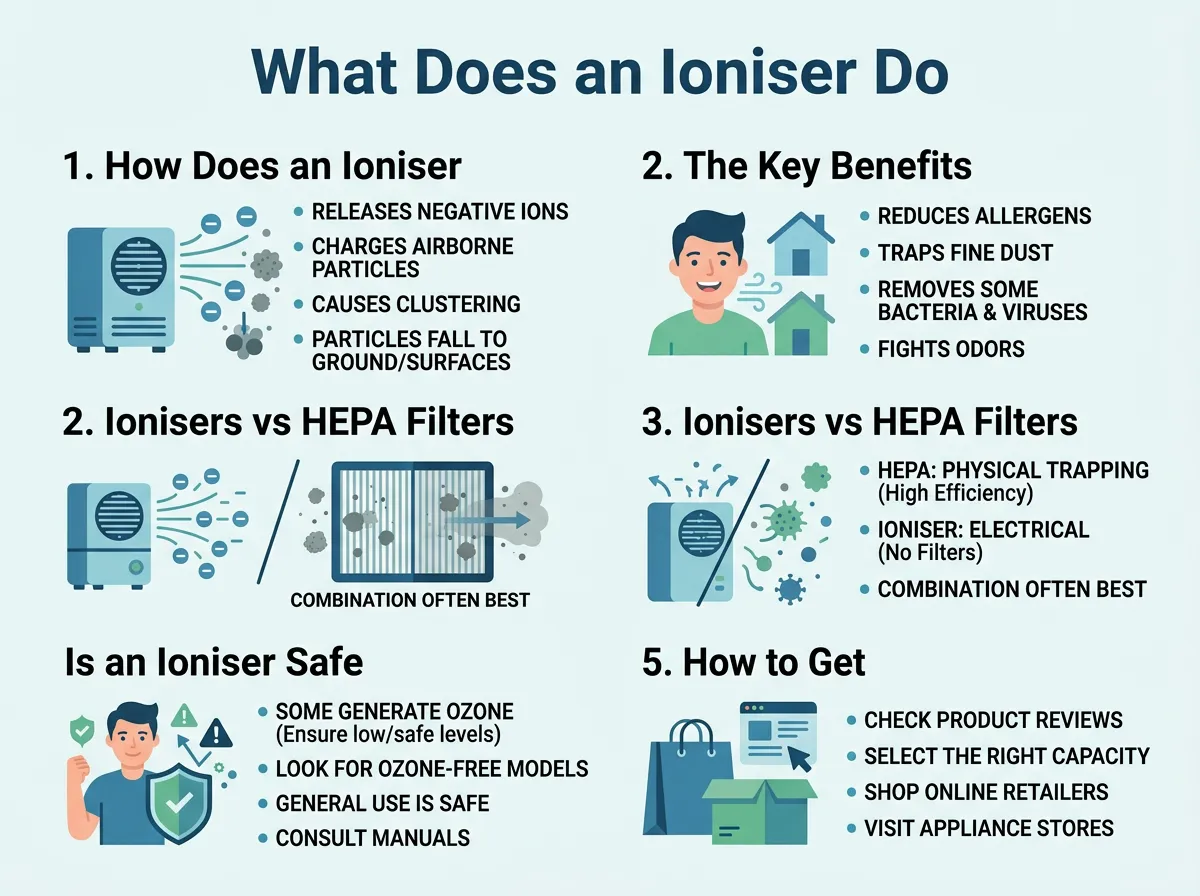
What Does an Ioniser Do? — key points at a glance
Removing Ultra-Fine Particles
Many common air filters struggle to catch very small particles, such as bacteria, viruses, and very fine dust. Because ionisers work at a molecular level, they are highly effective at targeting these tiny irritants. They clump them together so they can no longer drift into your lungs.
Reducing Odours and Secondhand Smoke
If you cook a lot, have pets, or live with a smoker, you know how hard it is to get rid of smells. Smoke particles are incredibly small and can linger in a room for hours. Negative ions are excellent at binding to smoke particles. This makes them drop to the floor rapidly, which quickly reduces the smell and haze in the air.
Low Maintenance and Quiet Operation
Most traditional air purifiers rely on powerful fans to force air through thick filters. These fans can be quite noisy, especially if you run them in a bedroom. Many ionisers do not use large fans at all, meaning they operate almost silently. Furthermore, because many models do not use physical filters, you do not have to buy expensive replacements every few months.
Ionisers vs. HEPA Filters: What is the Difference?
When shopping for an air cleaner, you will likely see both ionisers and HEPA filters. It is easy to get confused by these terms. To understand what does an ioniser do, it helps to compare it directly to a HEPA filter.
How HEPA Filters Work
A High-Efficiency Particulate Air (HEPA) filter is a physical barrier. It is made of dense, randomly arranged fibers. A fan forces air through this mesh, trapping particles like dust, pollen, and pet hair inside the filter. The air comes out clean, and the dirt stays locked away inside the machine.
How Ionisers Work
An ioniser does not trap anything inside itself. Instead, it sends out ions to make the dirt fall onto the surfaces around your room. To learn more about this distinction, you can read Healthline’s review of how ionisers affect health. Because there is no physical trap, you must clean your room’s surfaces regularly. If you do not vacuum or dust, the particles can get kicked back up into the air when people walk by.
Combining Both Technologies
Many modern air purifiers do not make you choose between the two. They actually combine HEPA filters with built-in ionisers. In these hybrid machines, the ioniser clumps the tiny particles together first. This makes them larger and much easier for the HEPA filter to catch as air flows through the unit. This dual approach gives you the cleanest air possible.
Is an Ioniser Safe? Understanding Ozone
While discussing what does an ioniser do, it is vital to cover safety. You might have read some articles online raising concerns about these devices. Most of these concerns focus on a gas called ozone.
The Ozone Question
When an ioniser uses high voltage to charge air molecules, it can sometimes split oxygen molecules. This process can create ozone gas. While ozone high up in our atmosphere protects us from the sun, breathing it in close up is not good for your lungs. The Environmental Protection Agency’s overview of ozone-generating air cleaners warns that high levels of ozone can cause coughing, chest pain, and shortness of breath, especially for people with asthma.
How to Choose a Safe Ioniser
The good news is that technology has improved vastly over the years. Many modern ionisers are designed to produce zero or extremely low levels of ozone. When shopping for an ioniser, always look for safety certifications. Look for devices certified by the California Air Resources Board (CARB). These units are tested to ensure they do not emit harmful levels of ozone, making them safe for daily household use.
How to Get the Best Results From Your Ioniser
If you decide that an ioniser is right for your home, you will want to get the most out of it. Simply plugging it in is a great start, but a few simple tips can make it work much better.
Smart Placement Tips
Place your ioniser in an area with good airflow. Avoid tucking it away in a tight corner or behind heavy furniture. The negative ions need space to spread out and find the dust particles floating in the room. Putting the unit on a table or shelf in the center of your living space is often the best spot.
Keeping Up with Cleaning
Since an ioniser makes dust fall out of the air, you will notice that dust builds up on nearby surfaces a bit faster. This is actually a sign that the device is doing its job! To keep your home clean, make sure you wipe down nearby tables, walls, and shelves with a damp microfiber cloth.
Pairing with a Vacuum
To keep the settled dust from returning to the air, vacuum your carpets and rugs regularly. Using a vacuum with a HEPA filter is ideal. This ensures that when you clean up the dust that the ioniser dropped, it stays trapped inside the vacuum instead of blowing back out into your room.
Conclusion: Is an Ioniser Right for You?
So, what does an ioniser do in the end? It serves as an active air cleaner that helps clear the air of dust, smoke, and pollen by bonding them to surfaces. It is a quiet, low-maintenance option that can tackle very small particles that other filters might miss.
If you suffer from mild allergies, live with pets, or want to reduce smoke and odors, an ioniser can be a fantastic tool. Just make sure to choose a certified, low-ozone model and keep up with regular dusting. By combining an ioniser with a solid cleaning routine, you can enjoy a fresher, cleaner, and much more comfortable home environment.
Frequently Asked Questions
Do ionisers actually clean the air?
Yes, ionisers are highly effective at clearing tiny airborne particles like dust, smoke, and pollen from the air. They do this by charging these particles so they clump together and fall onto nearby surfaces. However, you will still need to dust and vacuum those surfaces to remove the particles permanently.
Do ionisers produce ozone?
Some older or lower-quality ionisers can produce small amounts of ozone as a byproduct of the electrical charging process. However, most modern, high-quality units are certified to meet strict safety standards that limit ozone production to safe, negligible levels. Always look for CARB certification or similar safety seals when purchasing.
Is it safe to leave an ioniser on all night?
Yes, it is generally safe to leave a modern, certified ioniser running all night. Since they operate quietly and use very little electricity, they can help keep your bedroom air clean while you sleep. Just make sure the device is certified to produce zero or extremely low ozone levels.
Can an ioniser help with allergies?
Yes, ionisers can be very helpful for people suffering from allergies. By making heavy allergens like pet dander, mold spores, and pollen fall out of the breathing zone, they can reduce your exposure to triggers. For best results, use them alongside a HEPA air purifier and regular cleaning.
Do I need to replace filters in an ioniser?
Traditional, pure ionisers do not have physical filters, so they do not require replacement filters. Instead, you only need to clean the internal plates or needles occasionally to keep them running efficiently. However, hybrid units that combine ionisation with HEPA filtration will still require regular filter changes.
Where is the best place to put an ioniser?
The best place to put an ioniser is on a flat, elevated surface like a table or shelf in the center of the room. This gives the negative ions plenty of space to disperse and circulate throughout the entire area. Keep it away from tight corners or heavy drapes that could block the flow of air.
