


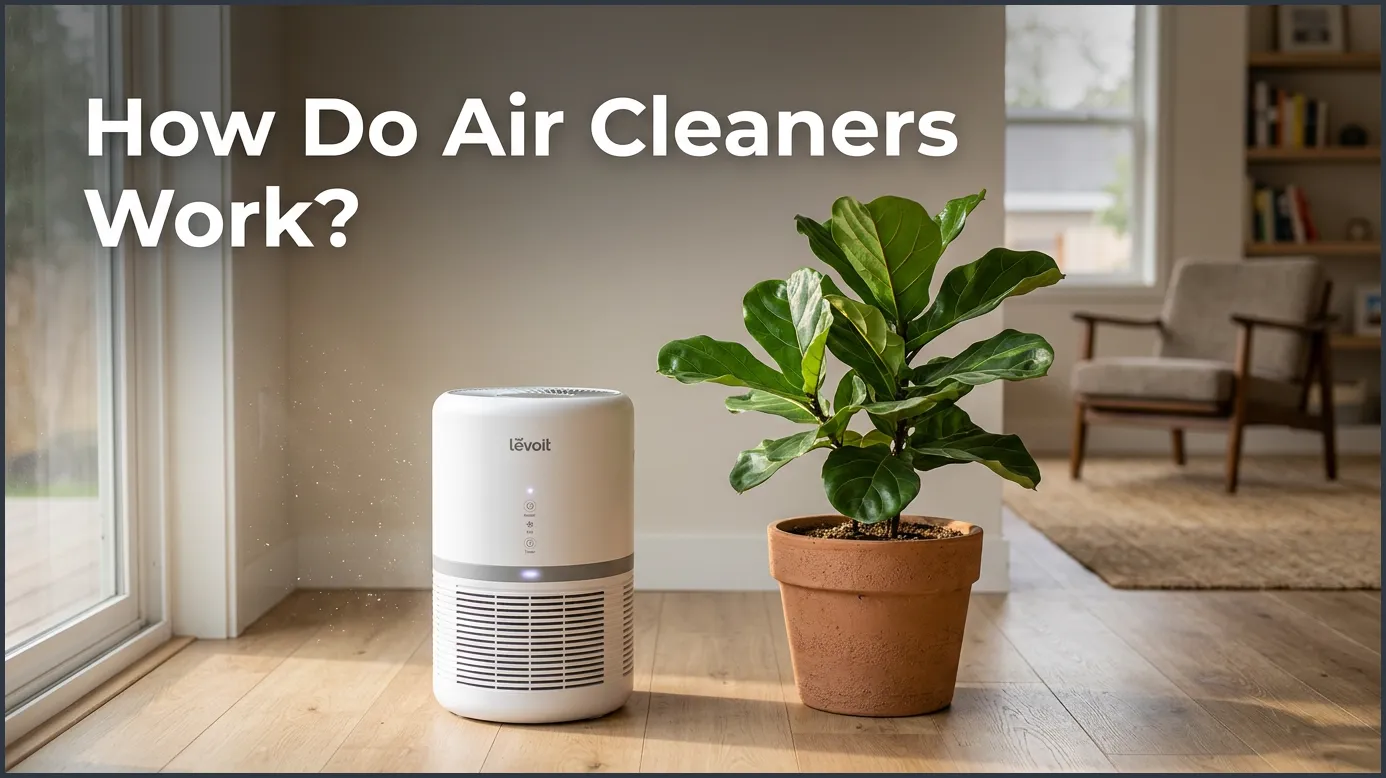
Air cleaners work by pulling dirty indoor air into the unit, passing it through physical filters that trap airborne pollutants, and pushing the clean air back into the room. They rely on advanced technologies like HEPA filters and activated carbon to target dust, allergens, chemical fumes, and odors. This continuous cycling significantly improves your indoor air quality and helps you breathe easier.
Have you ever watched tiny dust specks dance in a beam of sunlight? It can look beautiful, but it is also a quick reminder of what we breathe every day. Our indoor air is full of invisible guests. From dust mites and pet dander to pollen floating in from outdoors, our homes are often less clean than they look. This leads many of us to ask: how do air cleaners work?
Many people buy these devices hoping for a quick fix for allergies or stale odors. But before you plug one in, it helps to understand what goes on inside that plastic shell. Knowing the process can help you get the most out of your device. It also prevents you from falling for clever marketing traps. Let us lift the hood and see exactly how these devices capture the unseen particles in your home.
In this guide, we will explore the inner workings of air cleaners. We will cover the different types of filters, the science of capturing tiny particles, and how to choose the right device. By the end, you will know exactly how to keep your home’s air fresh and healthy.
Key Takeaways
- Multi-stage filtration: High-quality air cleaners use multiple filter layers to target different types and sizes of pollutants.
- The HEPA standard: True HEPA filters trap 99.97% of tiny microscopic particles, including pollen, mold, and pet dander.
- Odor control: Activated carbon filters are necessary to absorb gases, smoke, cooking smells, and chemical fumes.
- Continuous cycling: Air cleaners must run constantly to loop and clean the room’s air multiple times per hour.
- Smart placement: Placing your unit in an open space with good airflow leads to much better performance.
- Easy maintenance: Cleaning or replacing your filters on time keeps the machine running quietly and efficiently.
📑 Table of Contents
The Basic Mechanics of Air Filtration
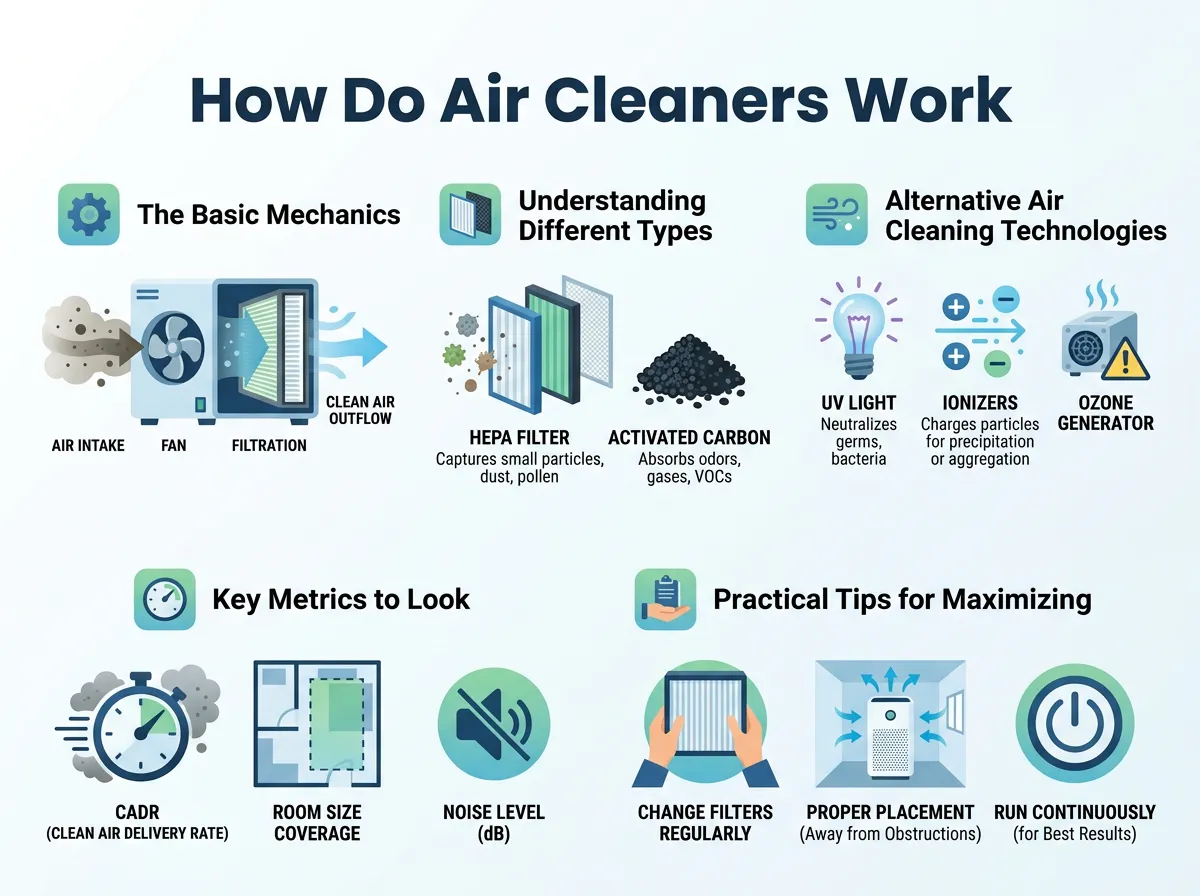
At their core, most air cleaners are surprisingly simple machines. They do not rely on complex chemical reactions to clean the air. Instead, they use a straightforward mechanical process. To answer how do air cleaners work, we must look at how air purifiers draw in and clean air through continuous circulation.
The Air Intake and Fan System
The journey begins with an electric motor and a fan. When you turn on an air cleaner, the fan spins to create a powerful vacuum. This fan pulls room air into the device. Some units pull air from the bottom, some from the sides, and others use a 360-degree intake. The speed of this fan determines how quickly the machine cycles your air. High speeds clean the air faster but make more noise. Lower speeds are quiet but process less air.
The Exhaust and Circulation Cycle
Once air is pulled inside, the fan pushes it through a series of internal filters. These filters act as physical barriers. They catch pollutants while letting clean air pass through. Once filtered, the clean air is blown back into the room. This continuous cycle is key. An air cleaner cannot clean your room in one single pass. It needs to run constantly, looping the air through its filters to keep pollutant levels low.
Understanding Different Types of Filters
Filters are the true workhorses of any air cleaner. Without them, an air cleaner is just a fan. When asking how do air cleaners work, the answer always comes down to the quality of the filters inside them. Most units use a multi-stage filtration system to catch different types of particles. If you want a deeper look at understanding how air filters work and what they block, you will find that different filters target specific particle sizes.
How Do Air Cleaners Work? — key points at a glance
Pre-Filters: The First Line of Defense
The pre-filter is the first barrier the air meets. It is usually made of mesh, foam, or polyester. The main job of a pre-filter is to catch the big stuff. This includes hair, large dust clumps, and pet fur. By catching these bulky items, the pre-filter protects the delicate filters deeper inside. This keeps the inner filters from clogging too quickly. Most pre-filters are washable, which saves you money on replacements.
HEPA Filters: The Gold Standard
Next, the air meets the star of the show: the HEPA filter. HEPA stands for High-Efficiency Particulate Air. To be a True HEPA filter, it must trap 99.97% of particles as small as 0.3 microns. To put that in perspective, a human hair is about 70 microns wide. HEPA filters easily trap tiny particles like pollen, mold spores, and pet dander. These filters are made of a dense web of fiberglass fibers that catch particles as they pass through.
Activated Carbon: Eliminating Odors and Gases
HEPA filters are great for solid particles, but they cannot stop gases or odors. These gas molecules are too small and slip right through. That is where activated carbon filters come in. This charcoal is treated with oxygen to open up millions of tiny pores. These pores act like a chemical sponge. When smelly gases, smoke, or chemical fumes pass through, they stick to the carbon. This process is called adsorption.
Alternative Air Cleaning Technologies
While mechanical filters are the most common, some air cleaners use other methods to tackle airborne pollutants. These technologies are often combined with physical filters to create a more powerful system.
Ionizers and Electrostatic Precipitators
Ionizers do not rely on physical barriers. Instead, they release negatively charged ions into the air. These ions attach to airborne particles, giving them a charge. The charged particles then stick to nearby surfaces like walls or carpets. Some units use metal plates inside the machine to attract these charged particles. While effective, you must clean these plates regularly to maintain performance.
UV-C Light
Some air cleaners feature an internal UV-C light. This light is designed to destroy the DNA of biological pathogens like viruses and bacteria. When these tiny germs pass through the light chamber, the radiation neutralizes them so they cannot reproduce. While this technology sounds advanced, the air must stay under the light long enough to be fully effective.
Key Metrics to Look For: CADR and ACH
When shopping for an air cleaner, you will see a lot of technical terms. Two of the most important metrics are CADR and ACH. Knowing these numbers will help you find a unit that fits your living space.
Clean Air Delivery Rate (CADR)
CADR is a standard measurement created by appliance manufacturers. It measures how quickly an air cleaner filters out smoke, dust, and pollen. The higher the CADR, the faster the unit cleans the air. Look for a CADR rating that matches your room size. A good rule of thumb is the two-thirds rule. The CADR should be at least two-thirds of your room’s square footage.
Air Changes Per Hour (ACH)
ACH tells you how many times the air cleaner can exchange all the air in a room within one hour. If a unit has an ACH rating of 4, it cleans the air four times every hour. For allergy sufferers, an ACH rating of 4 or 5 is highly recommended. For general freshness, an ACH of 2 is plenty.
Practical Tips for Maximizing Your Air Cleaner
Simply buying an air cleaner is not enough. You need to use it correctly to get the best results. To understand more, you can look at technical insights on air purification systems and how they operate in home environments.
Perfect Placement Strategies
Where you place your air cleaner matters. Do not hide it behind a couch or tuck it into a tight corner. These devices need plenty of space to draw in and blow out air. Try to keep at least two feet of clear space around the unit. Placing the unit near the source of pollutants—like near a pet bed—is also a smart move.
Maintenance and Filter Replacement
Over time, filters fill up with trapped dust and hair. When a filter gets clogged, the fan has to work harder. This lowers efficiency and uses more power. To avoid this, clean your pre-filter every few weeks. Replace your HEPA and carbon filters every six to twelve months. Many modern air cleaners have indicator lights to remind you.
Making Your Air Cleaner Work for You
While air cleaners are highly effective, they work best when combined with other clean-air habits. They should not be your only line of defense. According to research on whether air purifiers work for health, these devices are most effective when paired with regular cleaning. Vacuuming carpets, washing bedding, and keeping humidity levels low can prevent mold growth. Together with a quality air cleaner, these habits will keep your indoor air clean, fresh, and healthy for years to come.
Frequently Asked Questions
Do air cleaners remove odors?
Yes, air cleaners can remove odors if they contain an activated carbon filter. The carbon filter uses tiny pores to adsorb smoke, cooking smells, and chemical fumes. Standard HEPA filters alone cannot trap these gaseous odors.
How often should I run my air cleaner?
For the best results, you should run your air cleaner continuously on a low setting. Air pollutants are constantly entering your home, so continuous operation ensures the air is always being filtered. Most modern units are designed to be energy-efficient for this purpose.
Can an air cleaner help with pet allergies?
Yes, air cleaners are very effective at reducing pet allergies. A True HEPA filter can trap microscopic pet dander and hair suspended in the air. This significantly lowers the amount of allergens you breathe in while indoors.
Where is the best place to put an air cleaner?
The best place to put an air cleaner is in the room where you spend the most time, such as your bedroom or living room. Ensure it has at least two feet of clear space on all sides so the airflow is not blocked by walls or furniture.
Do air cleaners kill viruses and bacteria?
Some air cleaners can trap or neutralize germs. HEPA filters can capture many airborne bacteria, while units equipped with UV-C light or specialized sanitizing filters can destroy the DNA of viruses to render them harmless.
What is the difference between a pre-filter and a HEPA filter?
A pre-filter is a washable mesh designed to catch large particles like pet hair and dust clumps. A HEPA filter is a dense, high-efficiency fiber web that traps microscopic particles down to 0.3 microns, which easily pass through pre-filters.
