


Yes, HEPA filters are highly effective at removing mold spores from the air, capturing 99.97% of particles as small as 0.3 microns. While they trap airborne spores to prevent them from spreading, they do not kill mold or fix the underlying moisture problems causing the growth. To fully solve a mold issue, you must pair a HEPA air purifier with moisture control and direct source cleanup.
Imagine coming home after a long, busy day. You open your front door, expecting a breath of fresh air. Instead, you are met with a damp, stuffy scent. It smells a bit like wet soil or old, dusty books. You search your rooms, but you cannot find any water leaks. Yet, you find yourself sneezing more than usual. Your nose feels stuffy, and your throat feels dry and scratchy.
These small clues often point to one common household problem: indoor mold. Mold is a sneaky invader. It can grow behind your walls, under your carpets, or inside your dark closets. Before you even see a single dark spot, mold starts releasing its tiny seeds into your living space. These seeds are called spores, and they float through your home completely unnoticed.
If you want to protect your family and your health, you might look into getting an air purifier. This leads many homeowners to a big question: do HEPA filters remove mold? In this detailed guide, we will explore how these filters work. We will explain how they capture tiny particles, what they can do, and what you must do to keep your home clean and dry.
Key Takeaways
- High Efficiency: True HEPA filters trap 99.97% of airborne mold spores, which are typically between 2 and 20 microns in size.
- Capture vs. Kill: HEPA filters capture mold spores to keep them from circulating, but they do not destroy or kill them.
- Odor Control: An activated carbon filter is needed alongside a HEPA filter to remove the musty smells caused by mold.
- Safe Replacement: You must wear a mask and gloves when changing your filter to avoid breathing in trapped spores.
- Surface Limitations: Air purifiers only clean the air; they cannot remove mold already growing on walls, furniture, or carpets.
- Root Cause: Controlling indoor humidity and fixing leaks is the only way to stop mold from growing back permanently.
📑 Table of Contents
Understanding Mold and Airborne Spores
Mold is not just a messy eyesore on your bathroom tiles. It is a living organism that belongs to the fungi family. In nature, mold has a very important job. It breaks down dead wood, leaves, and plants. This helps keep the soil rich and healthy. But when mold starts growing inside your home, it becomes a major hazard.
How Mold Spreads
Mold cannot walk or crawl, but it has a very clever way of moving around. It creates millions of microscopic spores. These spores are so light that even a gentle breeze or a footprint on the carpet can carry them away. They float through the air, looking for a new place to land. If they land on a dry surface, they do nothing. But if they find moisture, warmth, and food, they wake up. Within 24 to 48 hours, they start to grow. They can eat wood, paper, carpet fibers, and even the dust on your walls.
The Health Risks of Mold Spores
Breathing in mold spores can cause a wide range of health issues. For many people, it triggers allergy symptoms. You might get a runny nose, itchy eyes, or a skin rash. If you have asthma, mold can cause a sudden and severe attack. Some types of mold also release toxic compounds called mycotoxins. Over time, breathing these in can make you feel tired, dizzy, or run-down. Keeping these spores out of your air is key to feeling your best.
How HEPA Filters Work Against Mold
To fight airborne mold, many experts recommend using an air purifier with a HEPA filter. Let us take a look at why these filters are so popular and how they function.
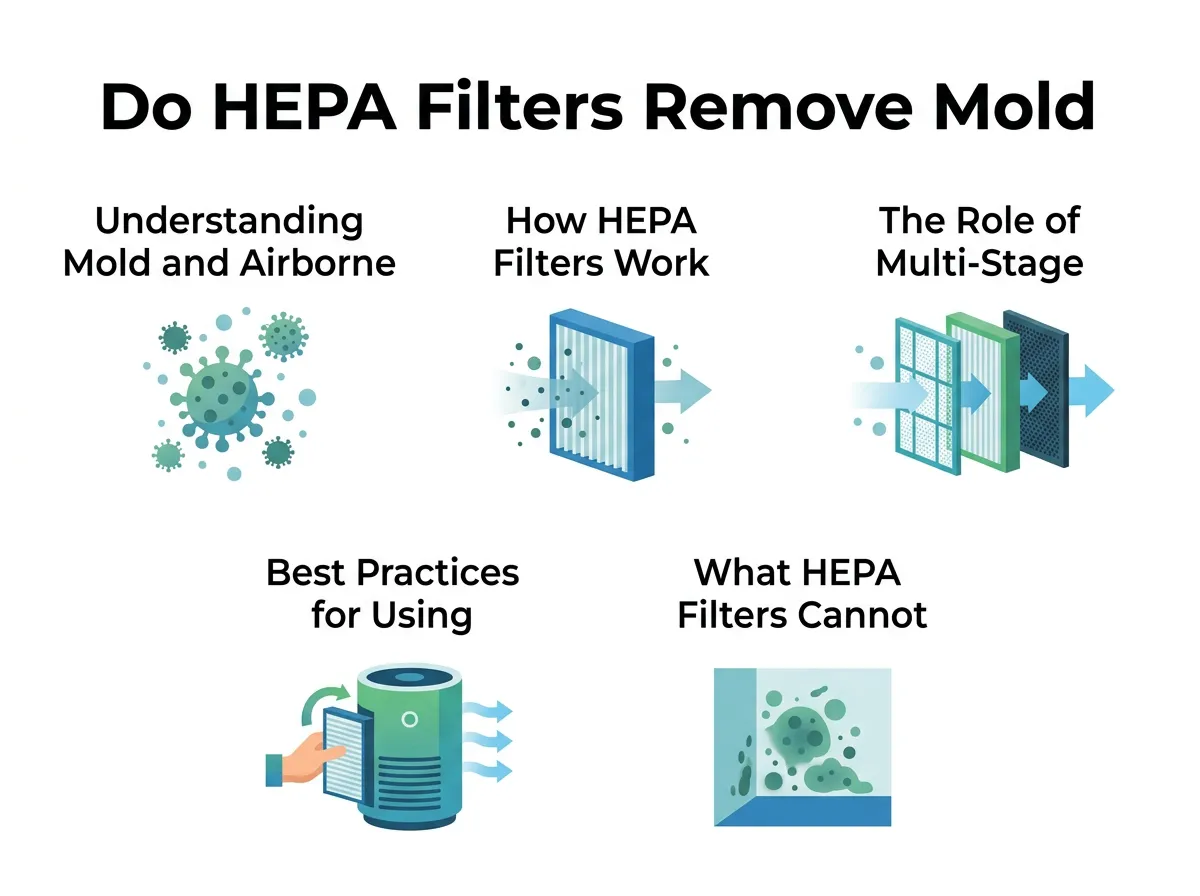
Do HEPA Filters Remove Mold? — key points at a glance
The Magic Number: 0.3 Microns
HEPA stands for High-Efficiency Particulate Air. To wear this label, a filter must meet strict government standards. It must trap at least 99.97% of particles that are 0.3 microns in size. This size is very important because it is the hardest size of particle to catch.
To understand how small this is, think about how small mold spores are. Most mold spores are between 2 and 20 microns wide. This means they are much larger than 0.3 microns. Because they are so large, a true HEPA filter has no trouble catching them. As the air flows through the filter, the dense web of glass fibers stops the spores in their tracks.
Capturing vs. Killing Mold
It is vital to know that HEPA filters capture mold, but they do not kill it. Do HEPA filters remove mold from the air? Yes, they do. But once the mold is trapped in the filter, it is still alive. If your home is very humid, the trapped spores might start to grow on the filter itself. To prevent this, many modern air purifiers use filters with special antimicrobial coatings. These coatings help stop mold from growing on the filter surface. Still, regular filter changes are the best way to stay safe.
The Role of Multi-Stage Filtration
A high-quality air purifier does not use just one filter. Instead, it uses a team of filters working together. This is called multi-stage filtration, and it makes a huge difference in how clean your air gets.
Pre-Filters: The First Line of Defense
The first part of this system is the pre-filter. This is usually a simple mesh screen made of plastic or fabric. It traps large items like pet hair, dust bunnies, and human hair. By catching these big pieces, the pre-filter protects the delicate HEPA filter. It keeps the HEPA filter from getting clogged too quickly. This helps your machine run better and saves you money on replacement parts.
Activated Carbon: Neutralizing Musty Odors
HEPA filters are amazing at catching solid particles like dust and mold. But they cannot catch gases, smoke, or smells. If you have mold, your home will probably have a musty smell. To get rid of this odor, you need an activated carbon filter. This filter uses treated carbon to trap gases and odors. It locks the smell away, leaving your air smelling clean and fresh.
Best Practices for Using Air Purifiers to Control Mold
Getting a new air purifier is a great first step. But you must use it correctly to get the best results. Let us look at some practical tips for your home.
Where to Place Your Air Purifier
Place your air purifier in the room where you spend the most time. For most people, this is the bedroom. If you have a known damp spot, like a laundry room, kitchen, or basement, put one there too. Make sure the machine has plenty of space around it. Do not place it behind a door, under a desk, or tight against a wall. It needs at least one to two feet of open space on all sides to pull in air from the whole room. Keep your windows and doors closed while the unit is running to keep outdoor mold from rushing in.
Maintenance and Safe Filter Replacement
You must change your HEPA filter on time. Most filters last between six months and a year. If you live in a very humid area, you might need to change it sooner. When you replace a filter, do it carefully. Remember, the old filter is holding thousands of live mold spores. Do HEPA filters remove mold safely? They do, as long as you do not shake those spores back into your air during a change. Wear a face mask and rubber gloves. Take the old filter out gently. Put it straight into a plastic trash bag, tie it shut, and take it outside to your trash can right away.
What HEPA Filters Cannot Do (Setting Realistic Expectations)
While HEPA air purifiers are great tools, they have limits. It is important to know what they cannot do so you can set realistic goals for your home cleanup.
The Surface Mold Limitation
An air purifier can only clean the air. It cannot clean physical surfaces. If you have mold growing on your walls, ceiling, or wooden furniture, a HEPA filter will not remove it. You must wash those surfaces with soap and water, white vinegar, or a professional mold cleaner. Once you scrub the mold away, your air purifier will catch any spores that flew into the air during the cleaning process.
The Root Cause: Moisture and Humidity
Mold cannot grow without water. If you have a leaky pipe, a dripping roof, or high humidity, mold will always find a way back. An air purifier does not remove moisture from the air. To stop mold for good, you must fix the water problem. Keep your home dry. Use exhaust fans in your bathroom and kitchen. If your home is very damp, use a dehumidifier to keep the humidity below 50%.
Do HEPA filters remove mold on their own? No, they must be part of a bigger plan. You must combine air filtration with moisture control and physical cleaning to keep your home mold-free forever.
Conclusion
To sum it up, do HEPA filters remove mold? Yes, they are highly effective at trapping the airborne spores that cause allergies and spread mold around your home. They act as a powerful shield, cleaning your indoor air and protecting your health. But remember, they are just one part of the puzzle. You also need to clean existing mold from surfaces and keep your home dry. By combining a true HEPA air purifier with good moisture control, you can create a fresh, clean, and mold-free living space for you and your family.
Frequently Asked Questions
Can mold grow inside a HEPA filter?
Yes, mold can grow inside a HEPA filter if it becomes damp or is kept in a highly humid room. To prevent this, keep your home’s humidity low and replace your filter according to the manufacturer’s instructions. Many filters also feature antimicrobial coatings to help stop mold from growing on them.
Do HEPA filters remove mold smell?
A HEPA filter alone cannot remove mold smells because it only traps solid particles, not gases or odors. To get rid of the musty mold smell, you need an air purifier that includes an activated carbon filter. The carbon filter will trap the odor molecules and make your air smell fresh again.
How often should I change my HEPA filter if I have mold?
If you have an active mold problem, you should check your filter every three to six months. While standard filters can last up to a year, heavy mold spores and dust will clog the filter much faster. Changing it early ensures your air purifier continues to run at peak efficiency.
Will a dehumidifier or an air purifier work better for mold?
Both tools serve different purposes and work best when used together. A dehumidifier removes the moisture that mold needs to grow, which stops new mold from forming. An air purifier with a HEPA filter removes the existing mold spores that are already floating in your air.
Can a HEPA filter clean mold off walls?
No, a HEPA filter cannot clean mold that is already growing on walls, ceilings, or furniture. You must physically clean those surfaces using water and soap, vinegar, or a mold remover. The air purifier will only capture the spores that escape into the air while you are cleaning.
Do UV light air purifiers kill mold better than HEPA?
UV light air purifiers can kill mold spores, but they often require the spores to be exposed to the light for a long time to work. A true HEPA filter is actually more reliable because it physically traps 99.97% of the spores instantly. For the best protection, look for a system that combines both technologies.
