


Yes, air ionizers do work to remove floating particles from the air, but they have major limits. They release negative ions that make dust, smoke, and pollen clump together and drop to the floor. However, they do not actually destroy gas or odors, and some models can produce harmful ozone.
Have you ever watched a single beam of sunlight stream through your living room window? If you look closely, you will see a tiny, swirling universe of dust, pet dander, and lint floating right in front of your face. It is a bit shocking to realize we breathe these invisible particles in every single day. In our quest to create a healthier, cleaner living space, many of us start looking into various air cleaning gadgets. During your search, you have likely run across a glowing device called an air ionizer.
These sleek machines promise to clear the air using the power of electricity. They sound incredibly high-tech, like something out of a science fiction movie. But when you are spending your hard-earned money, you want to know the real story. Do Air Ionizers Work? Or are they just another overhyped appliance that will sit in the corner collecting dust instead of clearing it? Let us dive into the science, the safety concerns, and the daily reality of using these devices in your home.
To help you make the best choice for your family, we will break down exactly how these machines operate. We will weigh their pros and cons, compare them to other popular air cleaning methods, and give you practical tips on how to use them safely. By the end of this guide, you will have a clear, honest answer to your questions.
Key Takeaways
- Particle Removal: Ionizers are highly effective at pulling dust, pollen, and cigarette smoke out of the air.
- No Filters: Unlike HEPA purifiers, most pure ionizers do not use physical filters to trap particles; they simply make them heavy so they fall.
- The Ozone Risk: Some ionizers release ozone as a byproduct, which can cause throat irritation and respiratory issues.
- Incomplete Cleaning: Ionizers do not remove gaseous pollutants, chemical fumes, or unpleasant smells.
- Best as a Hybrid: For the cleanest and safest home environment, ionizers work best when combined with a true HEPA filtration system.
📑 Table of Contents
What is an Air Ionizer and How Does It Work?
To understand if these devices are worth your money, we first need to look at how they operate. Most traditional air purifiers use a fan to pull dirty air through a physical paper or fabric filter. An air ionizer does something completely different. It does not rely on physical barriers to catch dirt. Instead, it uses chemistry and electricity to target airborne particles directly in your room.
The Science of Negative Ions
Inside an air ionizer, there are small metal needles or built-in plates that receive a high-voltage electrical current. This current creates negative ions. Ions are simply molecules that have gained or lost an electrical charge. In this case, the machine pumps out billions of negatively charged ions into your room. To fully grasp this process, you can read more about the air ionizer working principle, which details how electrical charges interact with molecules in our indoor atmosphere.
How Ionizers Trap Particles
Once these negative ions enter your room, they act like tiny magnets. Most floating particles in your air, such as dust, pollen, mold spores, and pet dander, have a positive charge. Since opposites attract, the negative ions quickly attach themselves to these positive particles. This bonding process makes the particles heavy. Once they become too heavy to float in the air, they drop down. They land on your floors, your walls, your couches, and your tables.
Do Air Ionizers Work? Evaluating the Efficiency
Now we get to the core question: Do Air Ionizers Work? The simple answer is yes, they do work, but they might not work in the exact way you expect. They are highly efficient at clearing the air of floating solids, but they do not make those solids magically disappear.
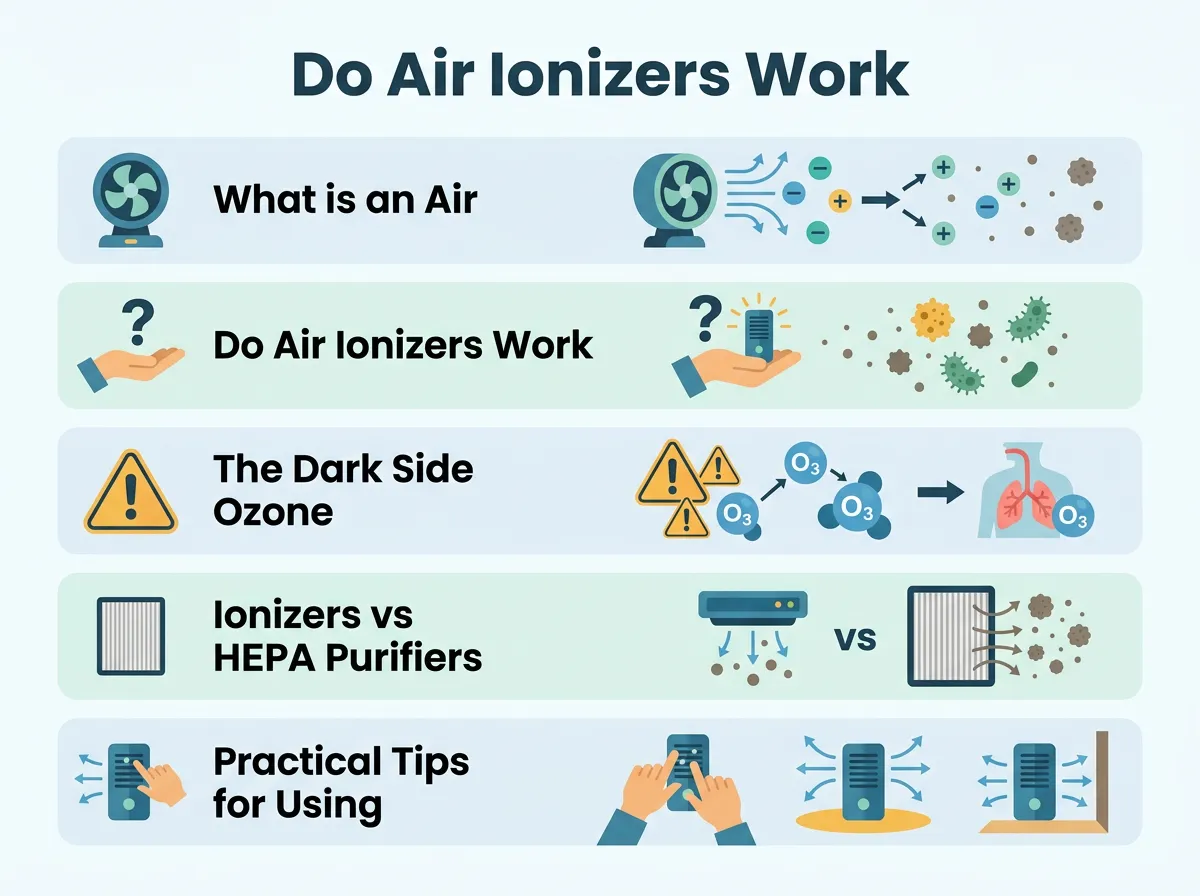
Do Air Ionizers Work? — key points at a glance
While they are great at clearing dust from the air, health experts at Healthline explain that what does an ionizer do extends to reducing bacteria but has limits with gaseous pollutants. Here is a closer look at what they do well and where they struggle.
What Ionizers Do Well
- Fine Particles: Ionizers are incredibly good at removing very small particles from the air. This includes fine dust and microscopic soot.
- Secondhand Smoke: If you struggle with cigarette smoke, an ionizer can quickly drop those smelly smoke particles out of the air.
- Quiet Operation: Because many ionizers do not have large, noisy fans, they run almost silently in the background.
Where Ionizers Fall Short
The biggest issue with a pure ionizer is that it does not trap the dirt. A HEPA filter traps dust inside a filter basket that you eventually throw away. An ionizer simply drops the dust onto your household surfaces. If you do not vacuum and dust your home immediately after, those particles can easily get kicked back into the air when you walk across the room. Additionally, ionizers cannot absorb gases, chemical fumes, or volatile organic compounds (VOCs) that come from household cleaners.
The Dark Side: Ozone and Health Concerns
Before you run out to buy an ionizer, you must understand a key safety concern. The process of creating negative ions can sometimes produce a gas called ozone. Ozone is a molecule made of three oxygen atoms. While ozone high up in our atmosphere protects us from the sun, ground-level ozone is a known lung irritant.
The Danger of Ground-Level Ozone
According to the EPA’s guide on ionizers and ozone-generating air cleaners, even small amounts of ozone can irritate your lungs and worsen asthma. When you breathe in ozone, it can cause chest pain, coughing, shortness of breath, and throat irritation. If you have asthma, allergies, or chronic obstructive pulmonary disease (COPD), an ozone-producing ionizer can make your symptoms much worse instead of better.
How to Spot a Safe Device
Thankfully, not all ionizers are dangerous. Many modern manufacturers have found ways to produce negative ions without creating harmful levels of ozone. When shopping, always look for units that are certified by safety boards. Look for the California Air Resources Board (CARB) certification. This group has strict limits on ozone emissions for indoor air cleaning devices.
Ionizers vs. HEPA Purifiers: Which is Better?
If you are trying to choose, comparing a traditional air purifier vs ionizer can help you see which technology fits your specific space. Let us compare these two popular options side by side.
The Power of HEPA Filtration
HEPA stands for High-Efficiency Particulate Air. A HEPA filter works by physically trapping 99.97% of particles that are 0.3 microns or larger. Once a dust mite or pollen grain enters a HEPA filter, it stays there. It cannot escape back into your room, and it does not settle on your coffee table. Furthermore, HEPA filters are completely safe. They do not produce any ozone or chemical byproducts.
Why a Hybrid System Wins
So, do air ionizers work better than HEPA filters? Generally, no. A HEPA filter is safer and more thorough for most households. However, many of the best modern air purifiers on the market today are hybrid systems. They combine a physical HEPA filter with an ionizer helper. The ionizer charges the incoming particles, causing them to clump together. These larger clumps are then much easier for the HEPA filter to catch. This combination gives you the best of both worlds.
Practical Tips for Using an Air Ionizer Safely
If you decide to buy an air ionizer, or if you already own one, you should take steps to use it safely and get the most out of it. Here are some simple, practical tips to follow:
Keep Your Room Well-Ventilated
Never run an ionizer in a tiny, sealed room with no airflow. Keep a window cracked open slightly, or ensure your home air conditioning system is running. Good ventilation helps prevent any potential ozone buildup in your living space.
Clean Surrounding Surfaces Regularly
Because ionizers make dust drop to the floor, you will notice a fine layer of dust on surfaces near the machine. This is sometimes called the “black wall effect.” Make sure to vacuum your carpet with a HEPA-vacuum and wipe down nearby tables and walls with a damp cloth at least once a week.
Use a Timer
You do not need to run your ionizer 24 hours a day. Run it for a few hours while you are out of the house to clear the air. This minimizes your personal exposure to any ozone or charged particles while still keeping your home clean.
Conclusion: Should You Buy an Air Ionizer?
In the end, do air ionizers work? Yes, they absolutely do work to clear floating dust and smoke from your personal breathing zone. They are quiet, energy-efficient, and great at tackling microscopic particles. However, they are not a perfect, magic cure for dirty indoor air.
Because they dump particles onto your floors and carry the risk of producing harmful ozone, they must be used with care. If you suffer from severe asthma or allergies, your safest bet is to choose a high-quality HEPA air purifier instead. If you want the absolute cleanest air possible, look for a certified hybrid system that uses both technologies safely. By understanding how these devices work, you can make the right decision to keep your home’s air fresh, clean, and safe for everyone.
Frequently Asked Questions
Do air ionizers remove smells and odors?
No, pure air ionizers are not designed to remove gases or odors from your home. To eliminate smells from cooking, pets, or chemicals, you need an air purifier equipped with an activated carbon filter.
Are air ionizers safe for pets?
Some air ionizers can be risky for pets, especially small animals and birds with sensitive lungs. If the ionizer produces even small amounts of ozone, it can cause respiratory issues for your furry or feathered friends.
Do I need to replace filters in an air ionizer?
Most pure air ionizers do not have physical filters, so you will not need to buy replacements. However, you will need to regularly clean the metal collection plates inside the device if it has them.
Where is the best place to put an air ionizer?
Place your ionizer in an open area with good airflow, ideally a few feet away from walls and furniture. This prevents the charged dust particles from clinging to your walls and staining them over time.
How can I tell if my ionizer is producing ozone?
If you notice a sharp, clean, or slightly metallic smell near your device, it is likely producing ozone. If this smell is strong or causes you to cough, you should turn off the device and move it to a larger room.
Can I leave an air ionizer on all night?
It is generally not recommended to leave an ionizer running all night in a closed bedroom. To sleep safely, look for an ozone-free model, or use a timer to run the device before you go to bed.
