


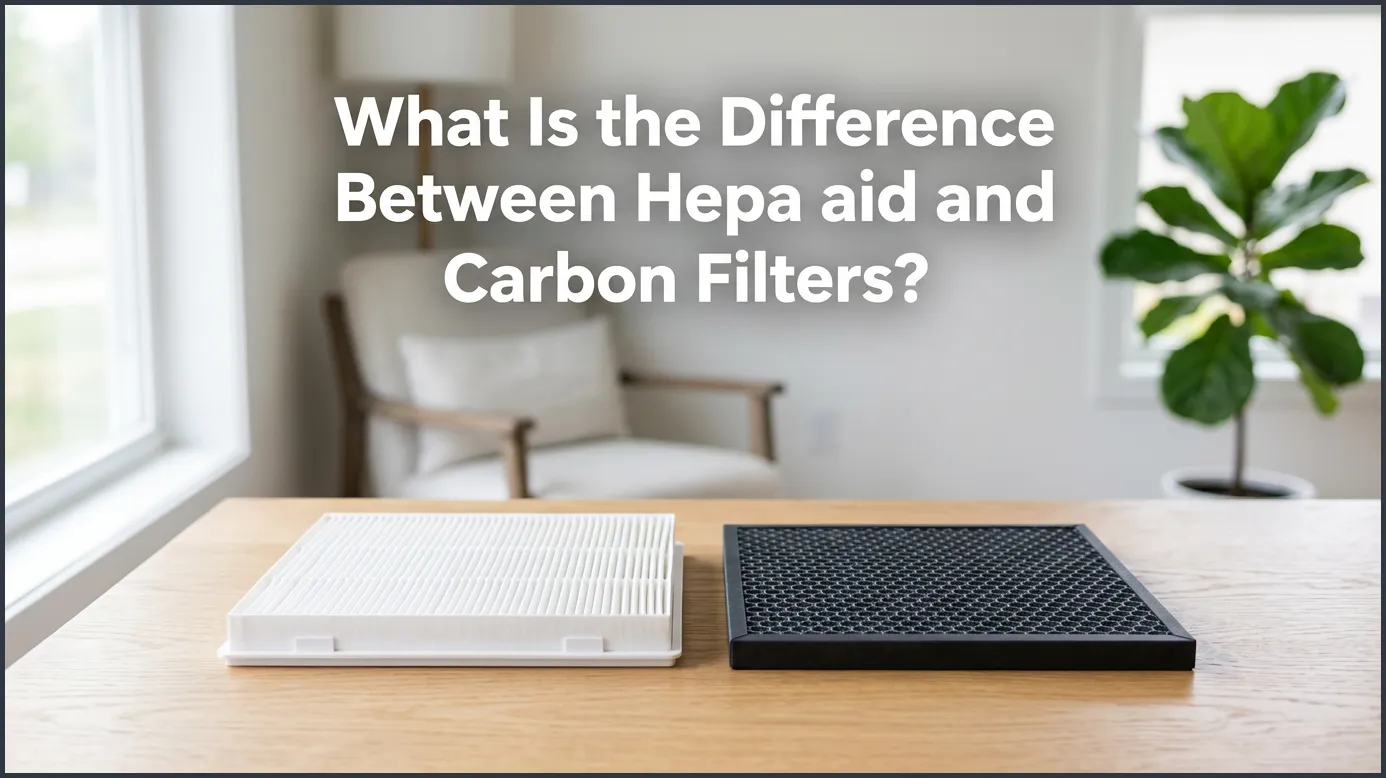
HEPA filters and carbon filters target entirely different types of indoor pollutants. While HEPA filters capture microscopic physical particles like dust, pollen, and pet dander, carbon filters absorb gases, odors, and chemical fumes. For the cleanest air possible, using an air purifier that combines both filter types is the ultimate solution.
Imagine walking into your home after a long day of work. You open the front door and take a deep, relaxing breath. But instead of fresh, clean air, you smell yesterday’s fish dinner. Or maybe you smell your dog’s wet fur. Perhaps you just start sneezing immediately because of the dust floating in the afternoon sunbeams. Indoor air can be full of surprises, and not all of them are pleasant.
When you want to clean your air, you start looking at air purifiers. Very quickly, you will see a lot of confusing words. You will see terms like True HEPA, activated carbon, VOCs, and microns. It can make your head spin. You might find yourself asking a very common question: What Is the Difference Between HEPA and Carbon Filters? It is a great question to ask before you spend your hard-earned money.
In this guide, we will break down everything you need to know in simple terms. We will look at how each filter works. We will explore what they can and cannot trap. By the end, you will be an expert on clean air, and you will know exactly which filter is best for your home and your health.
Key Takeaways
- Target Pollutants: HEPA filters capture solid particles, while carbon filters trap gaseous odors and chemicals.
- Filtration Methods: HEPA filters use physical traps (mesh fibers), whereas carbon filters use chemical adsorption (porous carbon).
- Complementary Power: The best air purifiers combine both filter types for complete air cleaning.
- Maintenance Needs: HEPA filters usually last up to a year, while carbon filters need replacement every three to six months.
- Allergy Relief: Choose a HEPA filter if your primary goal is reducing dust, pet dander, or seasonal allergy symptoms.
📑 Table of Contents
What is a HEPA Filter?
First, let us talk about HEPA. The letters in HEPA stand for High-Efficiency Particulate Air. This filter is a true champion when it comes to trapping solid particles. It is made of very thin fibers that are tangled together. These fibers form a tight, messy maze. When air passes through this maze, the particles get stuck.
How HEPA Filters Work
A HEPA filter does not work like a simple kitchen sieve. It is much smarter than that. It uses three main ways to catch particles as air flows through it. First, there is impact. Large particles fly straight in and crash into the fibers. Second, there is interception. Medium particles try to squeeze past the fibers but get caught on the sides. Third, there is diffusion. The tiniest particles bounce around like crazy pinballs until they hit a fiber and stick to it.
Because of this smart design, HEPA filters are incredibly effective. A true HEPA filter can trap 99.97% of particles that are as small as 0.3 microns. To put that in perspective, a single human hair is about 70 microns wide. That means a HEPA filter can catch things that are far too small for your eyes to see.
What HEPA Filters Capture
HEPA filters are perfect for physical particles. If it is solid and floating in the air, a HEPA filter will probably catch it. This includes common household pests like dust mites and their waste. It also includes outdoor invaders like tree pollen and grass pollen. If you have pets, a HEPA filter is your best friend because it traps pet dander and fur. It also stops mold spores and even some tiny bacteria from floating around your rooms.
What is a Carbon Filter?
Now, let us meet the other star of the air cleaning world: the carbon filter. This filter is also called an activated carbon filter or an activated charcoal filter. It looks very different from a HEPA filter. Instead of a white, paper-like sheet, a carbon filter is usually black. It is made of charcoal that has been treated with heat and oxygen.
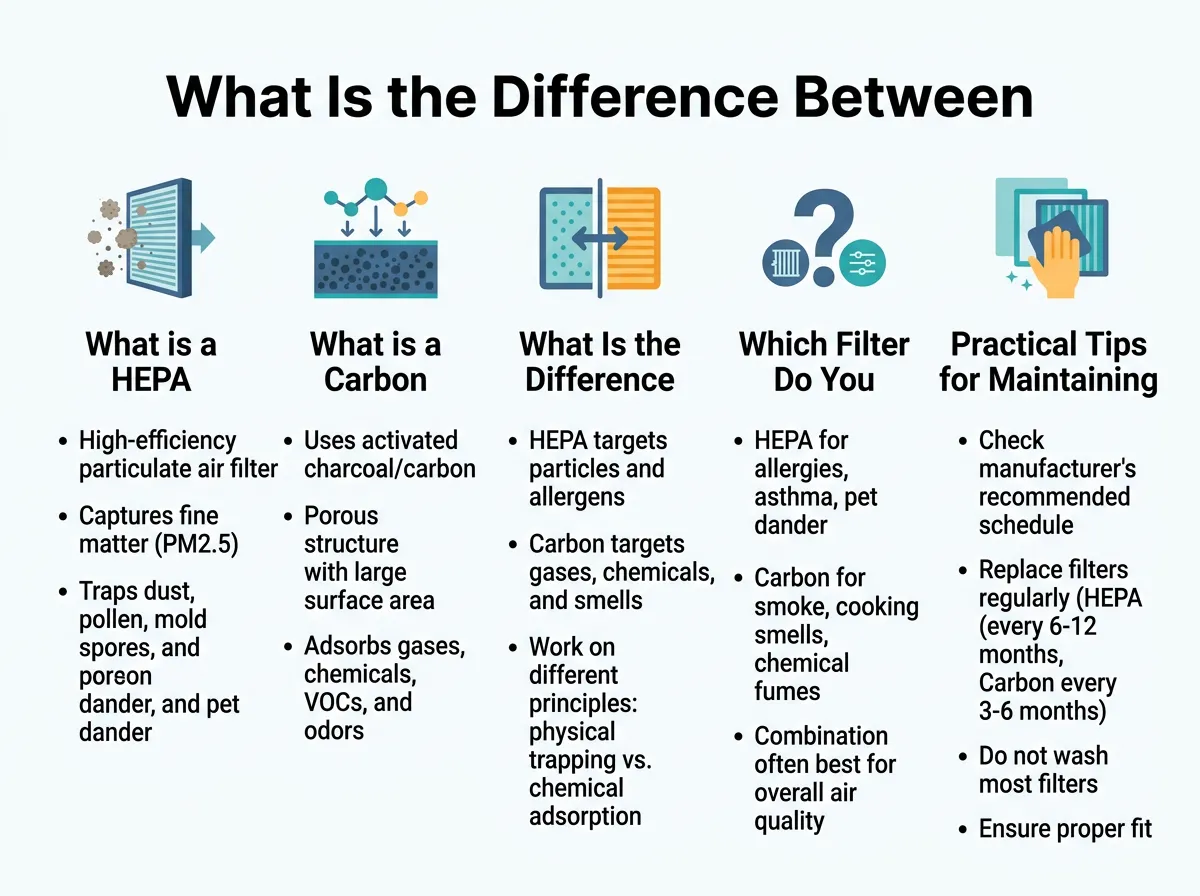
What Is the Difference Between HEPA and Carbon Filters? — key points at a glance
How Carbon Filters Work
This treatment makes the charcoal highly porous. It creates millions of tiny tunnels and pockets inside the carbon. In fact, just one gram of activated carbon has a surface area of over 500 square meters! That is about the size of a big basketball court. All that space is packed into a tiny piece of charcoal.
Carbon filters do not trap things physically like a net. Instead, they use a process called adsorption. Note the “d” in that word! Adsorption means that gas molecules stick to the surface of the carbon. When dirty air passes through the filter, gaseous pollutants and odors get trapped in those millions of tiny carbon pockets. They stick there and cannot get back out into your room.
What Carbon Filters Capture
Carbon filters are the ultimate odor busters. They are designed to trap gases, chemicals, and smells. If you cook with strong spices, a carbon filter will soak up the scent. If you paint a room, it will pull the chemical fumes out of the air. These chemical fumes are often called Volatile Organic Compounds, or VOCs for short. Carbon filters are also great at absorbing cigarette smoke, pet odors, and the smell of household cleaning sprays.
What Is the Difference Between HEPA and Carbon Filters?
To really understand What Is the Difference Between HEPA and Carbon Filters?, we must look at how they compare side by side. They are like two different tools in a toolbox. A hammer is great for nails, but it is terrible for screws. In the same way, these filters have very different jobs. Understanding understanding how HEPA and carbon filters compare is the key to creating a clean home environment.
Particle vs. Gas Filtration
The biggest difference is what they actually remove from the air. HEPA filters are made for solid particles. Carbon filters are made for gases and odors. A HEPA filter cannot stop a bad smell. The gas molecules of a smell are far too small. They will fly right through a HEPA filter without even slowing down. On the flip side, a carbon filter is not good at trapping dust or pollen. The heavy dust would quickly clog up all the tiny pores in the carbon, making it useless. You can read more about what each filter actually removes from the air to see how they split the work.
Material and Design Differences
The materials used to make these filters are very different. HEPA filters are made of fiberglass or special synthetic fibers. They are folded like an accordion to create more surface area. Carbon filters use actual coal, wood, or coconut shells that have been turned into activated carbon. Some carbon filters are thin sponges coated in carbon dust, while others are thick plastic grates filled with actual carbon pellets. The thick pellet filters are much better because they have more carbon to absorb smells.
Lifespan and Maintenance
When thinking about What Is the Difference Between HEPA and Carbon Filters?, you must consider how long they last. HEPA filters usually last quite a long time. In a typical home, you might only need to replace your HEPA filter once a year. Carbon filters are different. Once all the tiny pockets in the carbon are full of gas molecules, the filter stops working. It cannot hold any more smells. Because of this, you usually need to replace carbon filters every three to six months. If you live with smokers or have many pets, you might need to change them even more often.
Which Filter Do You Need for Your Home?
Now that you know the details, you might wonder which one you should buy. When deciding on What Is the Difference Between HEPA and Carbon Filters?, it helps to look at your own home and your health needs. Everyone has different air quality problems to solve.
Best for Allergies and Asthma
If you suffer from seasonal allergies, asthma, or other breathing issues, you need a HEPA filter. Your main enemies are pollen, dust mites, mold, and pet dander. These are all physical particles that irritate your nose and lungs. A HEPA filter will trap these particles and keep them out of your airways. It will help you sleep better and sneeze less.
Best for Odors, Pets, and Smoke
If your main goal is to get rid of smells, you need a carbon filter. Maybe you have a kitty litter box that smells. Maybe you love to cook garlic and onions. Or perhaps someone in your home smokes. A HEPA filter will not help with these smells. You need the heavy-duty gas-absorbing power of activated carbon to keep your home smelling clean and fresh.
The Ultimate Combo: Why You Should Not Choose Just One
Here is a secret: you do not have to choose! In fact, you should not choose just one. The best air purifiers on the market use both filters together. This is often called a multi-stage filtration system. In these systems, air first passes through a pre-filter to catch big dust bunnies. Then, it goes through a HEPA filter to trap tiny allergens. Finally, it passes through a carbon filter to remove smells and gases.
By using both, you get the best of both worlds. You get air that is free of dust and free of bad smells. You can learn about the pros and cons of each filter type to see why combining them is the smartest choice for most homes.
Practical Tips for Maintaining Your Filters
To keep your air clean, you must take care of your filters. Dirty filters cannot do their jobs well. They can also make your air purifier work harder, which uses more electricity and can shorten the life of the machine.
When to Replace Your Filters
Always write down the date when you install a new filter. Many purifiers have indicator lights that turn on when it is time for a change. However, these lights often run on simple timers. They do not know how dirty your air actually is. It is a good idea to check your filters visually every few months. If your HEPA filter looks dark grey or covered in thick dust, it is time for a new one. If your carbon filter stops stopping odors, replace it right away.
Cleaning vs. Replacing
Can you wash your filters to save money? Usually, the answer is no. Most HEPA filters are not washable. Getting them wet will ruin the delicate fiberglass maze, and they will stop trapping particles. Some filters are sold as washable, but they are rarely as effective as standard ones. Carbon filters should never be washed. Water will ruin the carbon pores and wash away the active ingredients. Always buy high-quality replacement filters to keep your system running safely.
Conclusion: Breathing Easy in a Clean Home
When you first ask yourself, “What Is the Difference Between HEPA and Carbon Filters?”, it can feel like a hard science lesson. But once you break it down, it is very simple. HEPA filters are the masters of physical particles like dust and pollen. Carbon filters are the champions of odors and gases like smoke and chemical fumes.
By understanding how these two technologies work, you can make the best choice for your family. For most people, a combination of both filters is the perfect way to ensure clean, healthy, and fresh air in every room. Take control of your indoor air today, and start breathing easier tomorrow!
Frequently Asked Questions
Can I wash a HEPA filter to reuse it?
Generally, you cannot wash a HEPA filter. Washing it with water will damage the delicate fiberglass fibers and destroy its ability to trap small particles. Always check your manufacturer’s guide, but it is usually best to replace it with a new one.
How often should I replace an activated carbon filter?
You should replace your activated carbon filter every three to six months. Because carbon filters work by absorbing gas molecules, their tiny pores will eventually fill up completely. Once full, the filter can no longer trap odors and must be swapped out.
Do HEPA filters remove bad smells and odors?
No, HEPA filters cannot remove bad smells or chemical odors. The molecules that make up gases and odors are far too small to be caught by the fibers of a HEPA filter. To eliminate smells, you need a carbon filter.
Do carbon filters remove dust and pet dander?
No, carbon filters are not effective at trapping physical particles like dust, pet dander, or pollen. These solid particles are too large and will quickly clog the tiny pores of the carbon filter, rendering it useless for odor control.
Should I use both HEPA and carbon filters together?
Yes, using both filters together is highly recommended. A HEPA filter traps solid allergens like dust and pollen, while a carbon filter absorbs odors and chemical fumes. Combining them gives you the most complete air cleaning possible.
Do HEPA filters catch viruses and bacteria?
True HEPA filters can capture many bacteria and some larger viruses that attach to floating particles. However, because some viruses are smaller than 0.3 microns, a standard HEPA filter may not trap all of them. For germ protection, look for purifiers that also include UV-C light or specialized sanitizing technologies.
