


Yes, a high-quality air purifier equipped with a True HEPA filter can significantly reduce dust in your home by trapping airborne particles before they settle on your furniture. While it cannot eliminate heavy dust that has already landed on surfaces, it is an incredibly effective tool for keeping your air clean and minimizing your cleaning routine. Combining an air purifier with regular vacuuming and dusting is the ultimate strategy for a dust-free living space.
Have you ever sat down on your favorite couch, looked at a beam of sunlight pouring through the window, and gasped at the dancing cloud of tiny specks floating in the air? It can feel like an endless battle. You wipe down your coffee table on Saturday, and by Monday, a thin gray film has already returned. This frustrating cycle leaves many homeowners wondering how to get ahead of the mess.
When looking for a solution, one question constantly comes up: Can an air purifier help with dust? While these sleek devices are famous for removing bad smells and smoke, their impact on daily dust buildup is often misunderstood. Some people expect them to act like magic vacuums that clean the entire room, while others worry they are just expensive fans.
In this guide, we will break down the science behind how these devices handle airborne particles. We will explore the composition of household dust, how filters capture it, and where the limits of these machines lie. Plus, you will learn practical steps to maximize your purifier’s performance and keep your home feeling fresh and clean.
Key Takeaways
- True HEPA filters are essential: They capture 99.97% of airborne particles as small as 0.3 microns, including fine dust and pet dander.
- Airborne dust only: Purifiers pull in floating dust but cannot clean dust that has already settled on carpets, tables, or couches.
- Placement matters: Placing your purifier in high-traffic rooms or near dust sources like pet beds increases its efficiency.
- Lower maintenance time: Using an air purifier reduces the frequency of manual dusting and vacuuming.
- Comprehensive approach: For best results, use purifiers alongside regular cleaning habits like using microfiber cloths and damp mopping.
📑 Table of Contents
What Exactly is Dust Made Of?
To understand how to fight dust, we first need to know what we are fighting. Many people think dust is just outdoor dirt that sneaks inside. However, household dust is a complex mixture of many different materials.
In a typical home, dust is made of:
- Dead skin cells from humans and pets
- Pet dander (microscopic skin flakes)
- Fibers from clothes, carpets, and upholstery
- Pollen carried in from the outdoors
- Microscopic mold spores
- Debris from tiny insects and dust mites
Because dust is made of so many light materials, it easily becomes airborne. Every time you walk across a rug, sit on a cushion, or shake a blanket, you launch millions of these tiny particles into the air. Once they are floating, they can easily enter your lungs or settle back down onto your shelves. Understanding this behavior is key to learning how to manage it. According to health experts, reducing these airborne irritants can significantly improve your respiratory comfort. You can read more about how dust impacts your well-being in this detailed dust and health guide from Verywell Health.
How Does an Air Purifier Help with Dust?
The short answer is yes, a purifier can absolutely help, but it helps in a very specific way. An air purifier works like a giant lung for your room. It draws in dirty air, traps the tiny particles inside a filter, and blows clean air back into the room.
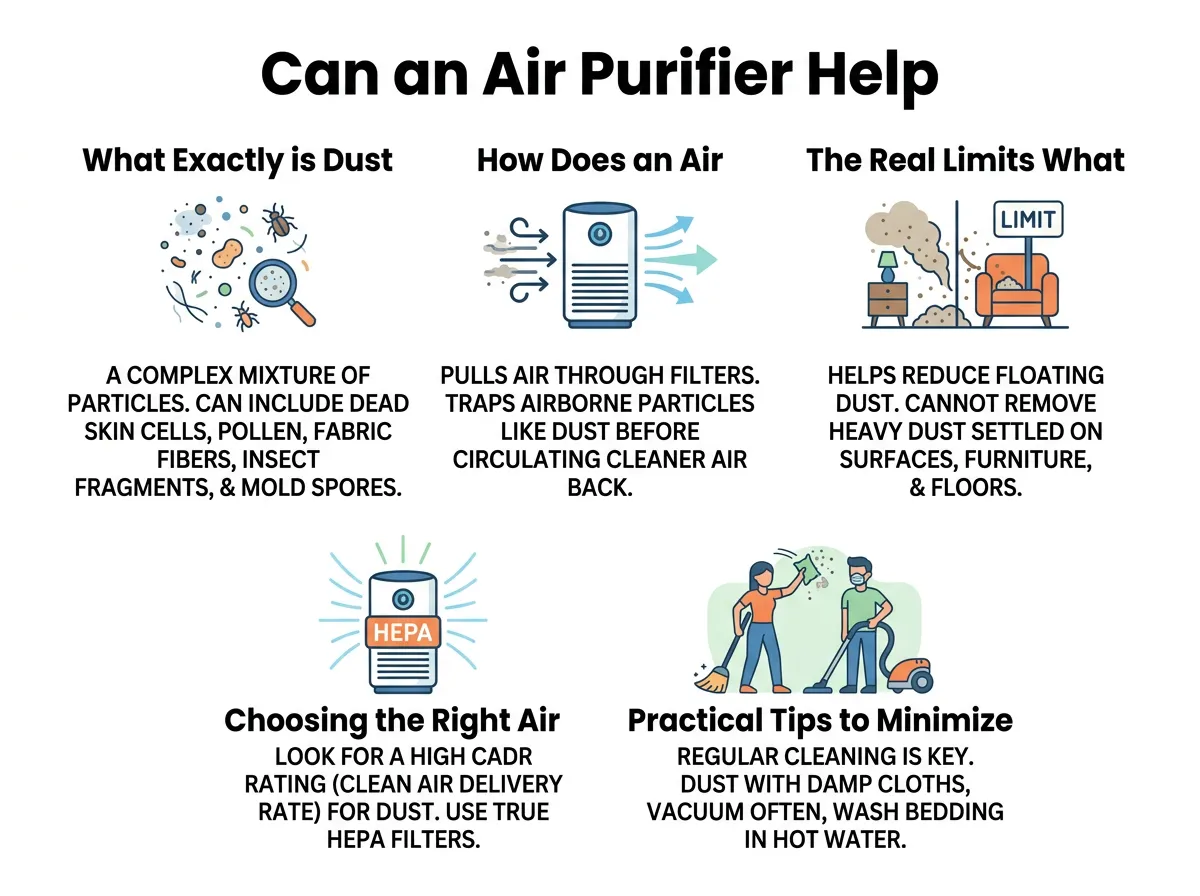
Can an Air Purifier Help With Dust? — key points at a glance
The Role of True HEPA Filters
When shopping for a device, the most important feature to look for is a True HEPA filter. HEPA stands for High-Efficiency Particulate Air. These filters are made of a dense web of tiny fibers. To earn the "True HEPA" label, a filter must be able to trap 99.97% of particles that are 0.3 microns in size or larger.
To put that in perspective, a single human hair is about 70 microns wide. Dust particles can range from 1 to 100 microns. This means a True HEPA filter can easily trap dust, pollen, mold, and pet dander. When the dirty air passes through the filter, the dust particles get tangled in the fibers and cannot escape.
The Airflow Cycle
For a purifier to work, it must keep the air moving. The device uses an internal fan to pull air into its intake vents. As the air moves through the unit, it passes through multiple stages of filtration. Most quality purifiers use a pre-filter first. This pre-filter catches large things like pet hair and big dust bunnies. This protects the delicate HEPA filter, allowing it to focus on the microscopic dust particles that do the most damage to your lungs.
The Real Limits: What a Purifier Cannot Do
While air purifiers are incredibly powerful, they are not miracle workers. It is important to set realistic expectations.
Settled Dust vs. Floating Dust
An air purifier can only clean the air that actually passes through it. This means it is highly effective at capturing floating dust. However, it cannot clean dust that has already settled on your furniture, floors, or curtains.
Once a dust particle falls out of the air and lands on a hard surface, it stays there. The fan of an air purifier is not strong enough to vacuum dust off your coffee table from across the room. To remove settled dust, you still need to use traditional cleaning methods. However, by capturing the dust while it is still floating, the purifier prevents a huge amount of dust from ever settling in the first place. This means you will not have to wipe down your shelves nearly as often.
Large vs. Small Particles
Gravity is another factor to keep in mind. Large, heavy dust particles do not stay in the air very long. They fall to the ground quickly. Because they fall so fast, the air purifier often does not have a chance to pull them in. On the other hand, tiny, lightweight dust particles can float in the air for hours. These are the particles that your purifier is best at capturing. It keeps these tiny allergens out of your nose and mouth, which is a major win for your health.
Choosing the Right Air Purifier for Dust Control
Not all air purifiers are created equal. If your main goal is to reduce dust, you need to look at specific features before buying.
CADR Rating Explained
CADR stands for Clean Air Delivery Rate. This rating tells you how fast the purifier can clean the air in a specific room. There are separate CADR ratings for smoke, pollen, and dust. When comparing models, look for a high dust CADR rating. The higher the number, the faster the machine can clear dust from your air.
Room Size and ACH
You also need to match the machine to the size of your room. An air purifier that is too small for your living room will not be able to process the air fast enough to make a difference. Look at the manufacturer's recommendations for square footage.
Additionally, pay attention to the ACH rating, which stands for Air Changes per Hour. This rating tells you how many times the machine can filter the entire volume of air in a room within one hour. For dust control, look for a machine with an ACH rating of 4 or 5. This means it cleans the air every 12 to 15 minutes, keeping dust levels consistently low. For more details on choosing a device that fits your space, check out the Southern Living guide on air purifiers for dust.
Practical Tips to Minimize Dust in Your Home
An air purifier is a team player. It works best when combined with a smart cleaning routine. Here are some of the best ways to keep dust at bay:
- Place the purifier correctly: Put your purifier in the room where you spend the most time, like your bedroom or living room. Keep it off the floor and away from walls so that air can flow freely around it. Many experts agree that placing it near potential dust entry points can maximize its effectiveness, as detailed in this Alen guide to air purifiers and dust control.
- Use microfiber cloths: Traditional feather dusters just kick dust back into the air. Microfiber cloths act like magnets, trapping the dust so you can wipe it away.
- Wash bedding weekly: Your bed is a major source of dust mites and dead skin cells. Wash your sheets, pillowcases, and blankets once a week in hot water to kill dust mites and wash away debris.
- Vacuum with a HEPA filter: Standard vacuums can spit fine dust back out into your room. Use a vacuum with a built-in HEPA filter to ensure the dust stays trapped inside the machine.
- Groom pets regularly: Pets shed a lot of hair and dander. Brushing them outside or in a designated area can stop that dander from floating through your house.
Conclusion
So, can an air purifier help with dust? The answer is a resounding yes. While it won't completely replace your duster or vacuum, a high-quality air purifier with a True HEPA filter is an essential tool in your cleaning arsenal. By pulling floating dust out of the air before it can settle on your furniture, it keeps your home cleaner, reduces your chore list, and helps you breathe easier.
By combining a great air purifier with smart cleaning habits like using microfiber cloths and regular vacuuming, you can finally win the battle against household dust. You will enjoy a fresher home, fewer allergy symptoms, and much more free time.
Frequently Asked Questions
Does an air purifier remove dust from furniture?
No, an air purifier cannot remove dust that has already settled on your furniture or floors. It only captures airborne dust particles that are floating in the air. To remove settled dust, you must wipe it down manually with a microfiber cloth.
Where is the best place to put an air purifier for dust?
The best place to put an air purifier is in the room where you spend the most time, such as your bedroom or living room. Keep it in an open area off the floor, at least three feet away from walls and furniture, so it has unrestricted airflow.
Do I still need to dust if I have an air purifier?
Yes, you will still need to dust your home, but you won't have to do it nearly as often. The air purifier captures a large portion of floating dust, which significantly reduces the amount of dust that eventually settles on your surfaces.
Can a regular filter catch dust, or do I need HEPA?
While basic filters can trap large dust clumps, you really need a True HEPA filter to capture fine, microscopic dust particles. HEPA filters trap 99.97% of particles down to 0.3 microns, ensuring that even the smallest dust and dander particles are removed from the air.
How long does it take for an air purifier to clear dust?
A properly sized air purifier can start clearing dust from a room within 15 to 30 minutes of being turned on. For the best results, you should keep the unit running continuously on a low or auto setting to maintain clean air.
Should I run my air purifier 24/7 for dust control?
Yes, it is highly recommended to run your air purifier 24/7 to keep dust levels low. Modern air purifiers are designed to be energy-efficient, and leaving them running continuously prevents dust from accumulating in the air while you are away or sleeping.
