


Running an air purifier is surprisingly cheap and will not break the bank. Most standard units use very little power, often costing only a few cents per day to run continuously. By choosing an Energy Star model, you can enjoy clean, fresh indoor air without worrying about a spike in your monthly utility bill.
Imagine waking up every morning with a clear nose and a fresh room. No more sneezing from dust. No more smelling yesterday’s dinner. For many of us, buying an air purifier seems like the perfect fix. But then, a quiet doubt creeps into your mind. You look at the device and wonder: Do Air Purifiers Use a Lot of Electricity?
It is a fair question to ask. After all, utility bills seem to rise every year. No one wants to add another hungry appliance to their home. If you must run a device all day to keep your air clean, you need to know its impact on your wallet.
In this guide, we will break down the numbers in simple terms. We will look at actual wattage, average monthly costs, and comparisons to items you already use. By the end, you will know exactly what to expect on your next energy bill and how to keep costs as low as possible.
Key Takeaways
- Low Power Needs: Most air purifiers use between 10 and 100 watts of power, depending on the speed setting.
- Affordable Monthly Costs: Running a standard air purifier 24/7 usually costs between $2 and $10 per month.
- Energy Star Savings: Certified Energy Star models are about 40% more energy-efficient than standard options.
- Fan Speed Impact: Lower fan speeds use significantly less electricity than the highest “turbo” setting.
- Smart Habits Help: Clean filters, auto-mode settings, and proper placement can further reduce your energy use.
📑 Table of Contents
Understanding Air Purifier Power Consumption
To answer our main question, we first need to look at how these machines work. An air purifier is actually a very simple device. It contains a fan and a set of filters. The fan pulls dirty air in, pushes it through the filters, and blows clean air back out. Because there are no heating or cooling elements inside, the power needs are quite low.
What Are Watts and Why Do They Matter?
Electric power is measured in watts. Think of watts as the speed at which a device drinks electricity. A lower wattage means the device drinks slowly. A higher wattage means it gulps energy down fast. When looking at any appliance, the watt rating tells you how much power it needs to run.
Typical Wattage of Air Purifiers
Most home air purifiers are very light drinkers. A small room unit might use only 10 to 20 watts. A medium-sized unit for a living room usually uses 40 to 60 watts. Even large, heavy-duty units designed for whole apartments rarely go above 100 watts on their highest setting. This is great news for your power bill.
How Much Does It Cost to Run an Air Purifier?
If you are asking, do air purifiers use a lot of electricity, looking at the daily math is the best way to get your answer. Many people believe that keeping any appliance on 24/7 will break the bank. Let us see if that is true for these air cleaners.
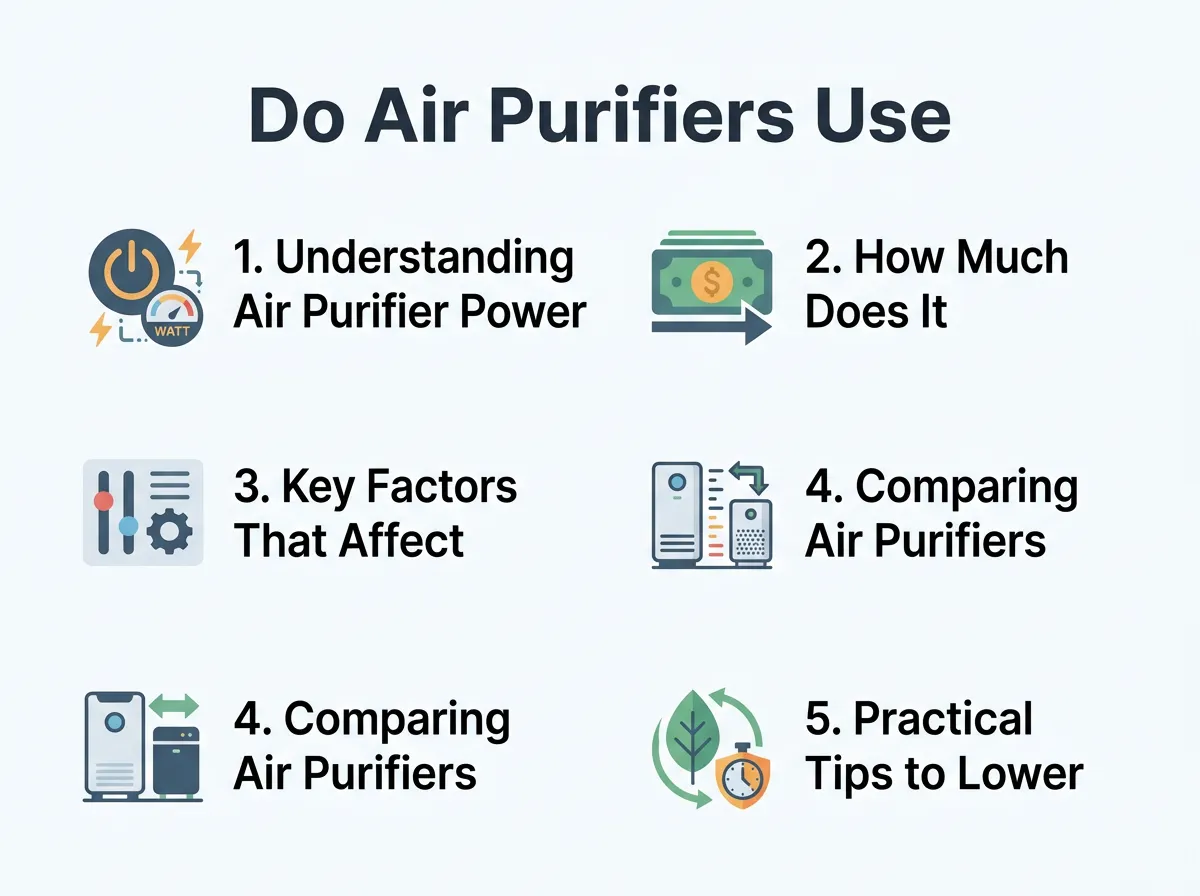
Do Air Purifiers Use a Lot of Electricity? — key points at a glance
The Simple Math of Energy Costs
Power companies bill you by the kilowatt-hour (kWh). One kilowatt-hour is equal to using 1,000 watts of power for one hour. To find your cost, you can use a basic formula. Multiply the device’s watts by the hours it runs. Then divide by 1,000 to get the total kWh. Finally, multiply that number by your local electricity rate.
For our examples, we will use an average US electricity rate of 16 cents per kWh.
Daily and Monthly Cost Examples
Let us look at a medium-sized air purifier that runs at 50 watts. If you run this unit all day and night, here is the math:
- 50 watts multiplied by 24 hours equals 1,200 watt-hours.
- 1,200 watt-hours divided by 1,000 is 1.2 kWh per day.
- 1.2 kWh multiplied by 16 cents is about 19 cents per day.
- Over a full month of 30 days, that is just $5.70.
Even if you have a larger unit using 80 watts, your monthly cost is only about $9.20. That is less than the price of a couple of fancy coffees. So, the short answer is no, they do not cost much to run at all.
Key Factors That Affect Energy Usage
While the math shows low average costs, your actual bill can vary. A few key factors can change how much power your device uses on a daily basis.
Fan Speed Settings
The speed of the fan is the biggest factor. When you run your purifier on “low” or “sleep” mode, it might use only 5 to 10 watts. If you boost it to “high” or “turbo” mode, the power use jumps up to the maximum wattage. Running a unit on high all the time will double your costs compared to running it on low.
Filter Type and Resistance
Thick filters like True HEPA filters do an amazing job of catching tiny particles. However, because the filter is dense, the fan must work harder to push air through it. If a filter gets clogged with dust, the motor works even harder. This extra struggle can slightly increase the power usage of the machine.
The Size of the Room and CADR
CADR stands for Clean Air Delivery Rate. It tells you how fast the unit cleans the air. A large room needs a unit with a high CADR. If you put a tiny unit in a massive room, it will have to run on high speed constantly to keep up. This wastes energy. Matching the unit size to your room is highly important for efficiency.
Comparing Air Purifiers to Other Household Appliances
To put things into perspective, let us compare our 50-watt air purifier to other things in your home. This helps us see how little energy these devices actually need to do their job.
Low-Power Comparisons
A standard ceiling fan uses about 75 watts on high. A typical laptop charger uses about 60 watts. This means running your air purifier uses less power than keeping a ceiling fan spinning, or keeping your laptop plugged into the wall.
High-Power Comparisons
Now, let us look at the heavy hitters. A microwave uses about 1,000 watts. A hair dryer uses 1,500 watts. A space heater also uses about 1,500 watts. Running a space heater for just one hour uses the same amount of power as running your air purifier for 30 hours! When you compare them this way, air purifiers are incredibly gentle on your electric grid.
Practical Tips to Lower Your Air Purifier’s Energy Bill
People often ask, do air purifiers use a lot of electricity when left on all day? The answer is still no, but you can save even more with these easy tips.
Use Smart or Auto Mode
Many modern air purifiers have built-in sensors. These sensors detect how dirty your indoor air is. In Auto Mode, the machine runs on low when the air is clean. It only speeds up when it detects dust, smoke, or pollen. This keeps power usage to an absolute minimum.
Clean and Replace Filters Regularly
When a filter is full of dirt, the fan has a hard time blowing air. Keep your filters clean. Vacuum the outer pre-filter if your model allows it. Replace the main filter as recommended by the maker. A clean machine is always an efficient machine.
Place the Purifier Correctly
Do not hide your air purifier behind a couch or in a tight corner. If air cannot flow easily, the unit cannot work well. Place it in an open area where air can circulate. This helps it clean the room faster so it can drop back to a lower fan speed sooner.
Use a Timer
If you are away at work all day, you might not need the machine running. You can use a built-in timer to turn the unit off when you leave. Set it to turn back on an hour before you get home so the air is clean when you walk through the door.
Choosing an Energy-Efficient Air Purifier
If you are shopping for a new unit, you can make energy savings a priority from day one. Here is what to look for when you browse the stores.
Look for the Energy Star Label
The Energy Star label is a trusted symbol. It means the government has tested the device for efficiency. Energy Star certified air purifiers are about 40 percent more efficient than standard models. Choosing one of these can save you a lot of money over the years.
Choose DC Motor Models
Look for units that feature a brushless DC motor. These motors are advanced and highly efficient. They use much less power than older AC motors. They are also much quieter, which is perfect for bedrooms and offices.
Conclusion
So, do air purifiers use a lot of electricity? The answer is a clear and happy no. These helpful devices are designed to run all day long without hurting your wallet.
For the price of a small cup of coffee each month, you can enjoy clean, fresh air. You can sleep better, breathe easier, and keep dust away. By choosing an Energy Star model and using auto settings, you can save even more. Go ahead and turn your air purifier on. Your lungs will thank you, and your energy bill will barely notice.
Frequently Asked Questions
Can I leave my air purifier on 24/7?
Yes, you can safely leave your air purifier on all day and night. Most models are designed for continuous use and have very safe, low-power motors. Running them constantly ensures your indoor air stays clean and free of allergens.
Does running an air purifier increase your electric bill?
Running an air purifier will increase your electric bill, but the amount is very small. For most standard units, the increase is only between $2 and $10 per month. This is a tiny cost for the health benefits of clean air.
Which air purifiers use the least electricity?
Air purifiers with the Energy Star label use the least amount of electricity. Models that feature advanced DC motors are also highly efficient. These units are designed to use up to 40 percent less energy than standard models.
Does fan speed affect how much electricity an air purifier uses?
Yes, fan speed has a major impact on power consumption. Running your unit on the lowest setting might use only 5 to 10 watts of power. Running it on the highest turbo setting can increase that usage to 50 to 100 watts.
Are air purifiers energy efficient?
Yes, air purifiers are highly energy-efficient appliances. Since they do not heat or cool the air, they only require enough power to spin a small fan. This makes them much more efficient than space heaters or air conditioners.
How many watts does a standard air purifier use?
A standard air purifier for a medium-sized room typically uses between 40 and 60 watts. Small desktop models can use as little as 10 watts, while very large units might use up to 100 watts. You can find the exact wattage printed on the back of your device.
