


Yes, high-quality air purifiers are highly effective at capturing airborne dust before it settles on your furniture. By utilizing True HEPA filters, these devices trap up to 99.97% of fine particles, significantly reducing dust buildup and improving your home’s overall air quality. However, they must be paired with regular cleaning to tackle heavy, already-settled dust.
You sit down on your comfy couch after a long day. A warm beam of sunlight streams through your living room window. Suddenly, you notice it. Thousands of tiny, glittering specks are dancing in the air right in front of you. You just dusted yesterday, yet here they are again. It feels like an endless battle against an invisible enemy. You might find yourself asking: does air purifier help with dust?
This is a common struggle for almost every homeowner. Dust is stubborn, unsightly, and can trigger annoying allergies. While we cannot stop dust from existing, we can change how we deal with it. Air purifiers have become incredibly popular in recent years, promising cleaner air and less cleaning. But do they actually deliver on these promises, or are they just expensive fans?
In this guide, we will explore exactly how these machines handle floating particles. We will look at what household dust is made of, how filtration technology works, and what these devices can and cannot do. By the end, you will have a clear action plan to make your home cleaner, fresher, and much easier to maintain.
Key Takeaways
- HEPA Filters Are Essential: True HEPA filters trap up to 99.97% of tiny dust particles.
- Pre-Filters Save Money: They catch large dust clumps and prolong the life of the main filter.
- Only Airborne Dust is Captured: Air purifiers cannot pull settled dust off furniture or carpets.
- Strategic Placement Matters: Keeping your purifier in high-traffic, open spaces boosts its power.
- A Team Effort: For the best results, use your purifier alongside regular vacuuming and damp dusting.
📑 Table of Contents
What Is Household Dust Made Of?
To solve the dust problem, we first need to know what we are actually fighting. Dust is not just dirt carried in from the backyard. It is a complex, constantly evolving mix of many different things that accumulate inside our living spaces.
The Surprising Ingredients of Dust
Most people think dust is just soil. In reality, household dust is a cocktail of dead skin cells, pet dander, hair, clothing fibers, and pollen. It also contains tiny bits of plastic, insect parts, and even microscopic dust mites. According to research on how air purifiers remove household dust, a large portion of dust actually comes from our own bodies and our pets. Every time we move, we shed thousands of tiny particles into our environment.
Why Dust Keeps Coming Back
We shed millions of skin cells every single day. Our pets do the same with their fur and dander. Every time we walk across a rug, open a window, or fold laundry, we create more dust. Because we are always active inside our homes, dust is constantly being made. It is a non-stop cycle. This is why many people wonder: does air purifier help with dust? They want a reliable tool that can keep up with this continuous buildup day and night.
How Air Purifiers Capture Airborne Dust
Air purifiers work by pulling air in, cleaning it, and pushing it back out. But how do they actually catch those tiny floating specks before they land? It all comes down to the clever filters inside the machine.
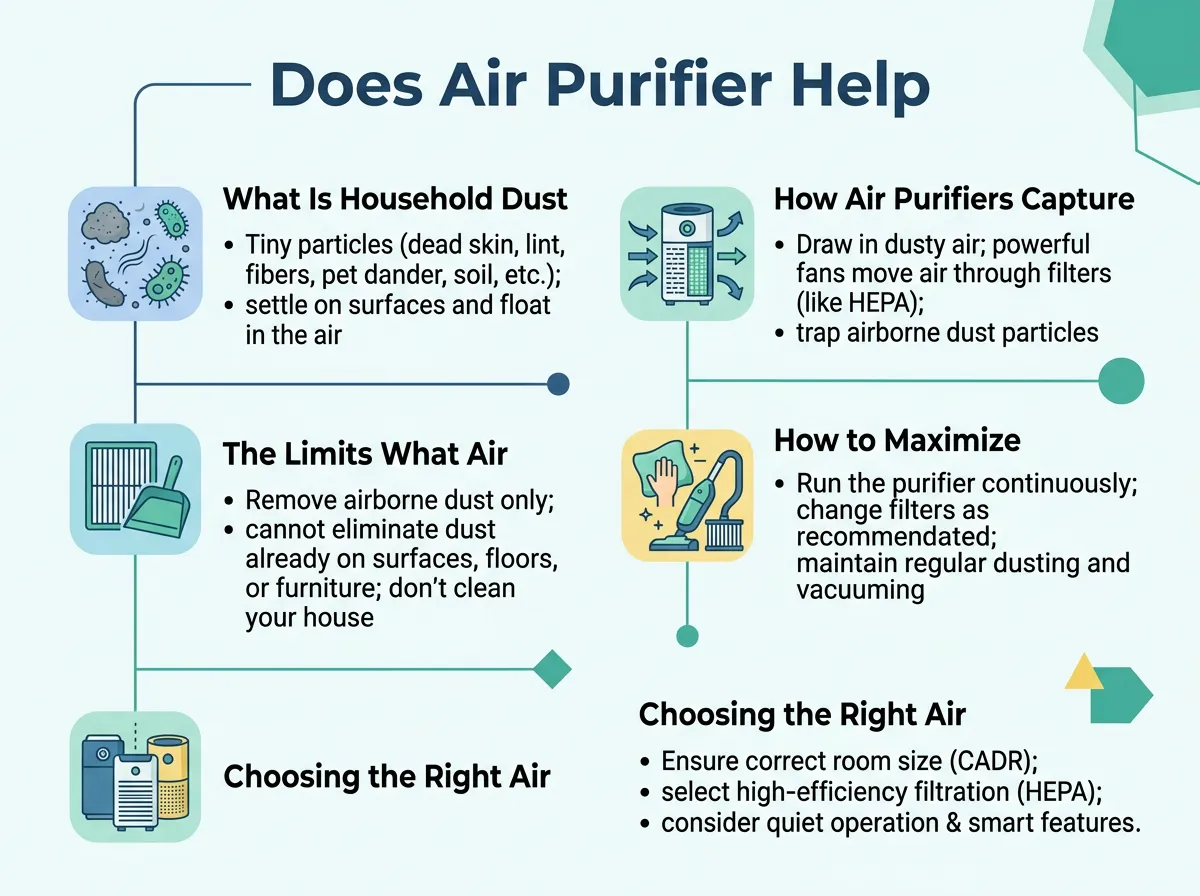
Does Air Purifier Help With Dust? — key points at a glance
The Magic of HEPA Filtration
The heart of any good air purifier is its filter. True HEPA filters are the gold standard for air cleaning. These filters are made of a dense web of very fine fibers. They can trap 99.97% of particles that are as small as 0.3 microns. To put that in perspective, a single human hair is about 70 microns wide. This means HEPA filters can easily catch fine dust, pollen, and pet dander. When looking into whether a device works, you might read guides about how air purifiers help with dust by trapping these micro-particles before they have a chance to settle on your tables.
The Role of Pre-Filters
Most good air purifiers do not rely on the HEPA filter alone. They also have a pre-filter. This is the first line of defense. The pre-filter is a coarser screen that catches larger particles like pet hair, carpet fibers, and big clumps of dust. If you are wondering, does air purifier help with dust by catching the smallest particles, the answer lies in this filter teamwork. By catching the big stuff first, the pre-filter prevents the HEPA filter from getting clogged too quickly. This keeps your machine running smoothly and makes your expensive filters last much longer.
The Limits: What Air Purifiers Can and Cannot Do
While these machines are incredibly helpful, they are not magic wands. To get the most out of your purchase, you need to understand their limitations.
Floating Dust vs. Settled Dust
Here is the most important rule of air cleaning: air purifiers can only clean the air. They cannot clean your furniture. When dust is floating in the air, the purifier can easily pull it in and trap it. But once dust settles on your bookshelves, TV stand, or carpet, the purifier cannot pull it back up. It does not act like a giant room-sized vacuum cleaner. So, does air purifier help with dust? Yes, but only when the dust is actively airborne.
Why You Still Need to Vacuum
Because dust eventually falls to the ground, you cannot throw away your vacuum cleaner just yet. Heavy dust particles fall quickly. Light dust particles can float for hours. A purifier will catch the light, floating particles before they land. For the heavy particles that land on your carpet, you will still need to vacuum and wipe down surfaces regularly. The good news is that a purifier will make these chores much easier and much less frequent.
How to Maximize Your Purifier’s Dust-Busting Power
If you want to get the best results, you cannot just plug in your purifier and forget about it. A few simple tweaks can make a huge difference in how much dust it collects.
Strategic Placement Secrets
Where you put your air purifier matters a lot. Do not hide it in a corner or behind a couch. It needs open space around it to draw in air from all directions. Place it in high-traffic rooms where you spend the most time, like your bedroom or living room. Keeping it off the ground, perhaps on a side table, can also help it catch floating dust before it hits the floor. Avoid placing it near drafts or open windows, which can disrupt its airflow pattern.
Maintaining Your Filters
An air purifier with a dirty, clogged filter cannot do its job. Check your pre-filter every few weeks. Many pre-filters can be vacuumed or washed with water. Check your main HEPA filter according to the manufacturer’s guide. Usually, they need to be replaced every 6 to 12 months. If you keep your filters clean, your machine will always run at peak performance, keeping your air free of dust.
Choosing the Right Air Purifier for Dust Control
Not all air purifiers are created equal. If dust is your main enemy, you need to look for specific features when shopping.
Key Features to Look For
Always choose a model with a True HEPA filter. Avoid “HEPA-type” or “HEPA-like” filters, which are not as efficient at catching tiny particles. You also want a model with a strong fan that can move a lot of air quickly. When shopping, you might ask, does air purifier help with dust if it has a carbon filter? While carbon filters are great for removing odors and gases, HEPA is what actually catches physical dust. For more tips on selecting a model, you can read this guide on how air purifiers help with dust and how to maintain a cleaner home.
Matching Room Size with CADR Ratings
CADR stands for Clean Air Delivery Rate. It measures how fast a purifier can clean the air in a specific room size. Look for a purifier with a high CADR rating specifically for dust. Make sure the unit is rated for the size of the room you want to put it in. If the machine is too small, it will not be able to clean all the air quickly enough to stop dust from settling on your surfaces.
A Complete Dust-Busting Action Plan
To truly win the battle against dust, you should use your air purifier as part of a larger cleaning team. Many people ask, does air purifier help with dust during deep cleaning days? The answer is yes, if you follow a smart routine.
Step-by-Step Cleaning Routine
Start by running your air purifier on its highest speed setting while you clean. This is the perfect time because cleaning kicks up a lot of dust into the air. Use a damp microfiber cloth to wipe down your surfaces. A dry cloth just pushes the dust back into the air, while a damp cloth traps it. Next, vacuum your floors using a vacuum equipped with a HEPA filter. Once you are done cleaning, let the air purifier run on high for another hour, then turn it down to a lower, quieter setting to maintain the clean air.
Conclusion
Dusting can feel like a never-ending chore. While an air purifier won’t completely eliminate the need to clean, it is an incredibly powerful ally. By trapping airborne dust, dander, and pollen, it keeps your air cleaner and your surfaces dust-free for much longer. If you are still wondering, does air purifier help with dust? The answer is a clear yes. When paired with a regular cleaning routine, a high-quality HEPA air purifier can transform your home into a fresher, healthier space.
Frequently Asked Questions
Can an air purifier replace regular dusting?
No, an air purifier cannot replace dusting completely. It only captures airborne dust before it has a chance to land on your furniture. You will still need to wipe down surfaces, but you will find yourself doing it much less often.
Where is the best place to put an air purifier for dust?
The best place is in the room where you spend the most time, such as your bedroom or living room. Keep it in an open area, away from walls or furniture, so it can easily pull in air. Placing it on a slightly raised surface like a side table can also help it catch floating dust.
Do air purifiers catch dust mites?
Yes, air purifiers with True HEPA filters can catch dust mites and their waste when they become airborne. However, because dust mites live deep inside carpets, mattresses, and couches, you must still vacuum and wash your bedding regularly.
How long should I run my air purifier to get rid of dust?
You should run your air purifier continuously on a low or automatic setting. Running it 24/7 ensures that new dust is trapped as soon as it enters the air. You can turn it to a higher speed while vacuuming or dusting to catch kicked-up particles.
Will a cheap air purifier help with dust?
A cheap air purifier can help, but only if it has a True HEPA filter. Many budget models use low-quality filters that let fine dust pass right through. Make sure to check the filter type and the room size rating before you buy.
Do ionic air purifiers work well for dust?
Ionic purifiers make dust particles heavy so they fall out of the air, but they do not always trap them. This means the dust lands on your floors and walls, requiring more cleaning. A HEPA purifier is a much better choice because it actually traps and removes the dust from your room.
