


An air ionizer cleans indoor air by releasing negatively charged ions into the environment. These ions bind to positively charged airborne particles like dust, pollen, and smoke, causing them to clump together and fall out of the air or stick to nearby surfaces. This process effectively removes microscopic allergens and impurities from the air you breathe.
Imagine walking deep into a forest after a fresh rain. The air feels crisp and clean. It feels alive. Now, think about your living room. Does it feel a bit stuffy? Is there a thin layer of dust on your table? Most of us spend a lot of time inside. We breathe in dust, pet dander, and pollen every day. It is no wonder we look for ways to clean our indoor air.
You may have heard of air purifiers. But as you shop around, you might run into a different kind of tool. You might ask yourself: what does an air ionizer do? It sounds like science fiction. It talks about ions, charges, and invisible fields. But the science is actually very simple. It is all about static electricity.
In this guide, we will look at how these devices work. We will explore what they do to your home. We will also compare them to normal filters and talk about safety. By the end, you will know if an ionizer is right for your space.
Key Takeaways
- Emits Negative Ions: The device releases charged molecules into the room to seek out airborne pollutants.
- Clumps Particles: Ions attach to tiny dust, pollen, and smoke particles, making them too heavy to float.
- Clears the Air: Heavy particles drop to the floor or cling to surfaces, removing them from your breathing zone.
- Reduces Odors: Ionizers are highly effective at neutralizing airborne smells and smoke.
- No Replacement Filters: Unlike HEPA purifiers, most simple ionizers do not require expensive filter changes.
- Requires Cleaning: Since particles fall onto surfaces, you must vacuum and dust your room more often.
📑 Table of Contents
How Does an Air Ionizer Work?
To understand what does an air ionizer do, we have to look at chemistry. Do not worry, we will keep it simple. Everything around us is made of atoms. These atoms have electrical charges. Some are positive, and some are negative.
The Science of Negative Ions
An air ionizer is a small electrical machine. When you plug it in, it starts to create negative ions. An ion is just an atom with an electrical charge. In this case, the machine adds an extra electron to oxygen molecules. This creates a negative charge. The machine then shoots these negative ions out into your room. They spread out like an invisible mist.
Charging the Dust Particles
Most things floating in your air have a positive charge. This includes dust, pollen, mold spores, and pet dander. You know that opposites attract. When the negative ions meet the positive dust, they stick together. It is just like static cling on your clothes. The negative ion bonds with the dust particle. Now, the dust has a charge too.
What Does an Air Ionizer Do for Your Home?
Once the ions attach to the dust, a chain reaction starts. This reaction changes how the particles behave in your room. This is the main job of the device.
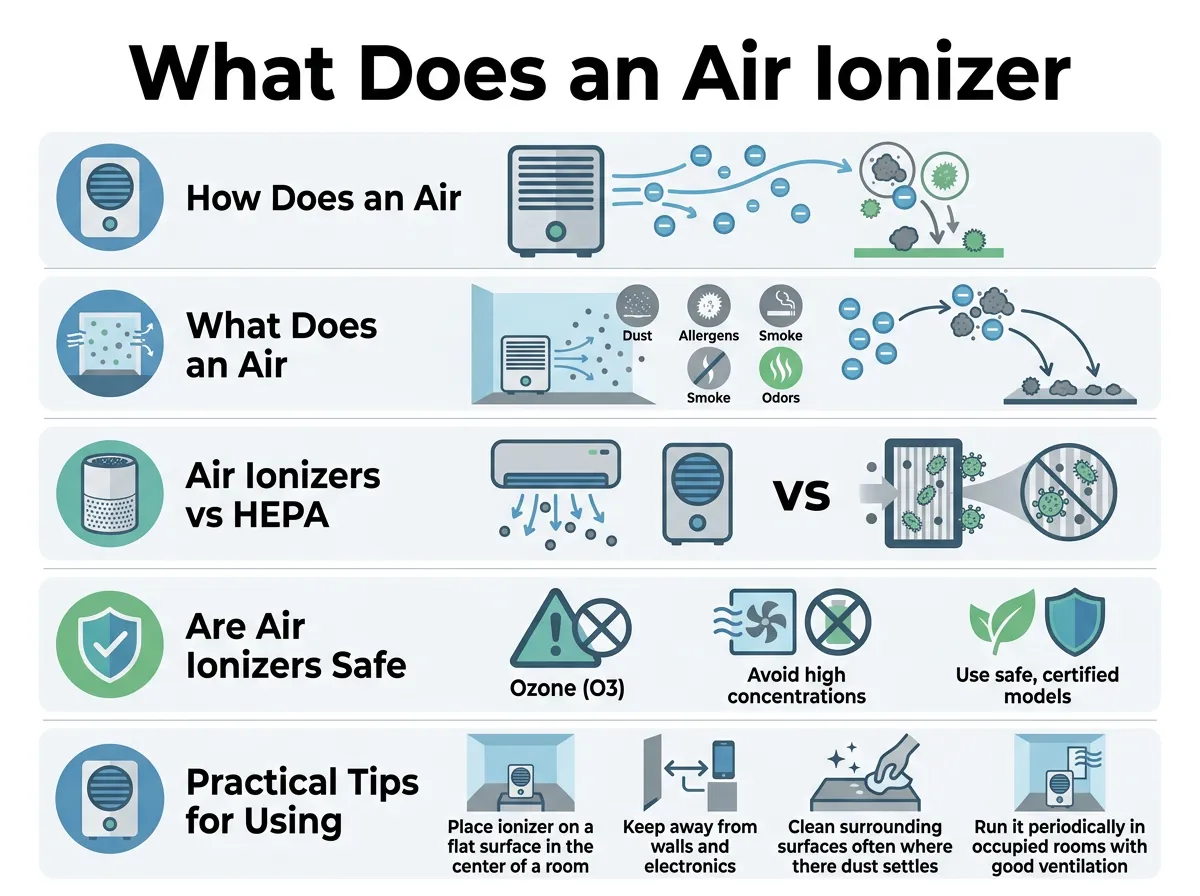
What Does an Air Ionizer Do? — key points at a glance
Eliminating Dust and Allergens
Single dust particles are very light. They can float in the air for hours. You breathe them in without knowing it. But when negative ions attach to them, things change. The particles start to clump together. They get bigger and heavier. Soon, they are too heavy to float. They fall out of the air. They land on your floor, your couch, or your walls. Once they are on the ground, you can no longer breathe them in.
Knocking Out Smoke and Smells
Ionizers are great at clearing smoke. Smoke is made of tiny particles of burnt material. These particles are very hard for normal filters to catch because they are so small. But ions do not care about size. They attach to the smoke particles quickly. They force them to drop to the ground. This helps clear the smell of burnt food or tobacco. It makes the air smell fresh again.
Air Ionizers vs. HEPA Filters: What is the Difference?
Many people confuse ionizers with standard air purifiers. While both clean the air, they do it in different ways. It helps to compare them side by side.
Trapping vs. Dropping Particles
A HEPA purifier uses a fan to pull air through a paper filter. The filter acts like a net. It traps the dust inside the machine. The clean air is then blown back into the room. An ionizer does not use a paper net. It does not trap anything inside itself. Instead, it sends ions out to drop the dust onto your floor. One traps the dirt inside a box. The other makes the dirt fall to the ground.
Maintenance and Filter Costs
HEPA purifiers can be expensive over time. You have to buy new filters every few months. If you forget, the machine stops working well. Ionizers are different. Most of them do not have physical filters. You buy the machine once, and that is it. There are no filters to replace. This can save you a lot of money over the years.
Are Air Ionizers Safe to Use?
This is a very important question. Ionizers are great at cleaning, but they have one main downside. You need to know about it before you buy one.
The Ozone Conversation
When ionizers create negative ions, they sometimes make ozone. Ozone is a gas made of three oxygen atoms. High up in the sky, ozone protects us from the sun. But inside your home, ozone can be bad. It can irritate your lungs. It can make you cough. People with asthma might find it hard to breathe around ozone. Some cheap ionizers make too much of this gas.
How to Choose a Safe Ionizer
You can still use an ionizer safely. You just need to shop smart. Look for devices that are certified. In the United States, look for the CARB certification. This means the California Air Resources Board tested the device. They make sure the machine produces almost zero ozone. These certified machines are safe for everyday use.
Practical Tips for Using Your Ionizer
If you decide to get an ionizer, you want to get the best results. Here are some easy tips to make it work better.
Placement is Key
Put your ionizer in an open area. Do not hide it behind a couch or a curtain. The ions need room to spread out. It is also wise to keep it away from white walls. Because the dust drops near the machine, it can leave dark spots on light walls over time. Put it on a wooden table or a tiled floor instead.
Regular Cleaning Routines
Remember, the dust does not vanish. It just lands on your floor and furniture. If you do not clean, the dust will just blow back up when you walk past. You must vacuum your carpets and wipe down your tables. Think of the ionizer as a helper that brings the dust down to where your vacuum can reach it.
Conclusion
So, what does an air ionizer do? In short, it acts like an invisible magnet for dust. It releases negative ions that cling to floating pollutants. It makes these particles heavy so they fall to the ground. This keeps them out of your lungs and makes your air feel clean and fresh.
While they are great at clearing smoke and saving you money on filters, they do require you to clean your floors more often. If you choose a safe, certified model, an air ionizer can be a wonderful tool for a healthier, fresher home.
Frequently Asked Questions
What is the difference between an air purifier and an air ionizer?
An air purifier uses a fan to pull air through a physical filter to trap dust. An air ionizer releases charged ions into the room to make dust clump together and fall to the floor.
Do air ionizers remove dust permanently?
No, they do not destroy the dust. They only force the dust to fall out of the air onto your floors and furniture, meaning you will need to vacuum and dust to remove it permanently.
Are air ionizers safe for pets?
Yes, most certified low-ozone ionizers are safe for pets. However, you should avoid using high-ozone models, as animals have sensitive lungs that can be easily irritated by ozone gas.
Do I need to replace filters in an air ionizer?
No, most standard air ionizers do not use physical paper filters. This makes them much cheaper to maintain over time compared to traditional HEPA purifiers.
Can I leave an air ionizer on all day?
Yes, you can leave a safe, CARB-certified ionizer on all day. Just ensure the room has decent ventilation and that the device does not produce harmful levels of ozone.
Why is there black dust around my ionizer?
This is called the black wall effect. It happens because the heavy, charged dust particles drop to the nearest surfaces, which are often the walls and floor right next to the machine.
