


The main difference between these two medical-grade filters is their filtration efficiency. While H13 filters capture 99.95% of particles down to 0.3 microns, H14 filters capture 99.995%. This tiny difference makes H14 filters ideal for sterile cleanrooms, while H13 filters are the standard for high-end home air purifiers.
Imagine walking into your living room and taking a deep, clean breath. No sneezing, no itchy eyes, and no dust tickling your nose. Clean air is vital for our health. Yet, our homes are often filled with tiny, invisible particles like dust mites, pet dander, and pollen. When wildfire smoke or winter allergies hit, many of us turn to air purifiers to protect our families.
As you shop for an air purifier, you will quickly see a lot of technical terms. You will see letters and numbers like H13 and H14. You might wonder, what do these ratings mean? Specifically, what is the difference between H13 and H14 HEPA filters? This is a very common question for anyone who wants to buy the best air cleaning system.
In this guide, we will break down these two filter types in simple terms. We will explore how they work, how much they cost, and how they compare. By the end, you will know exactly which filter fits your home, your health, and your budget.
Key Takeaways
- Efficiency Levels: H13 HEPA filters trap 99.95% of airborne particles, while H14 HEPA filters trap 99.995% of them.
- Airflow Resistance: H14 filters have tighter fibers, which creates more air resistance and requires a stronger, louder fan motor.
- Best Use Cases: H13 is the perfect choice for homes and offices, whereas H14 is designed for hospitals and industrial cleanrooms.
- Cost and Maintenance: H14 air purifiers and replacement filters are significantly more expensive than H13 models.
- The Sweet Spot: For most families, H13 offers the best balance of clean air, quiet operation, and affordable maintenance.
📑 Table of Contents
What is a HEPA Filter?
To understand the difference between these options, we must first look at the basics. What does HEPA stand for? It stands for High-Efficiency Particulate Air. These filters are not made of simple paper or plastic. Instead, they are made of thousands of tiny glass fibers tangled together in a dense mat. As air passes through, these fibers trap particles in several different ways.
If you want to understand the technology, understanding HEPA air filtration is the first step. HEPA filters are highly praised because they catch particles of all sizes. They trap large dust bunnies, medium pollen spores, and even tiny bacteria and viruses.
The EN 1822 Standard
Air filters are not classified by guesswork. In Europe, there is a strict standard called EN 1822. This standard tests and rates air filters based on how well they perform. The ratings go from E10 to U17. Under this system, H13 and H14 are classified as true “HEPA” filters. They are often called medical-grade filters because they meet such high standards of cleanliness.
The Concept of MPPS
To rate these filters, scientists test them using the Most Penetrating Particle Size (MPPS). This size is around 0.3 microns. Why 0.3 microns? It is because particles of this size are the hardest to trap. Larger particles hit the fibers and get stuck. Smaller particles bounce around randomly and get caught easily. But 0.3-micron particles can slide through easily. If a filter can catch these tricky particles, it can catch almost anything.
The Core Difference: Efficiency Levels
When you ask, what is the difference between H13 and H14 HEPA filters, the biggest answer is efficiency. Both filters are amazing, but one has a slightly tighter web of fibers.
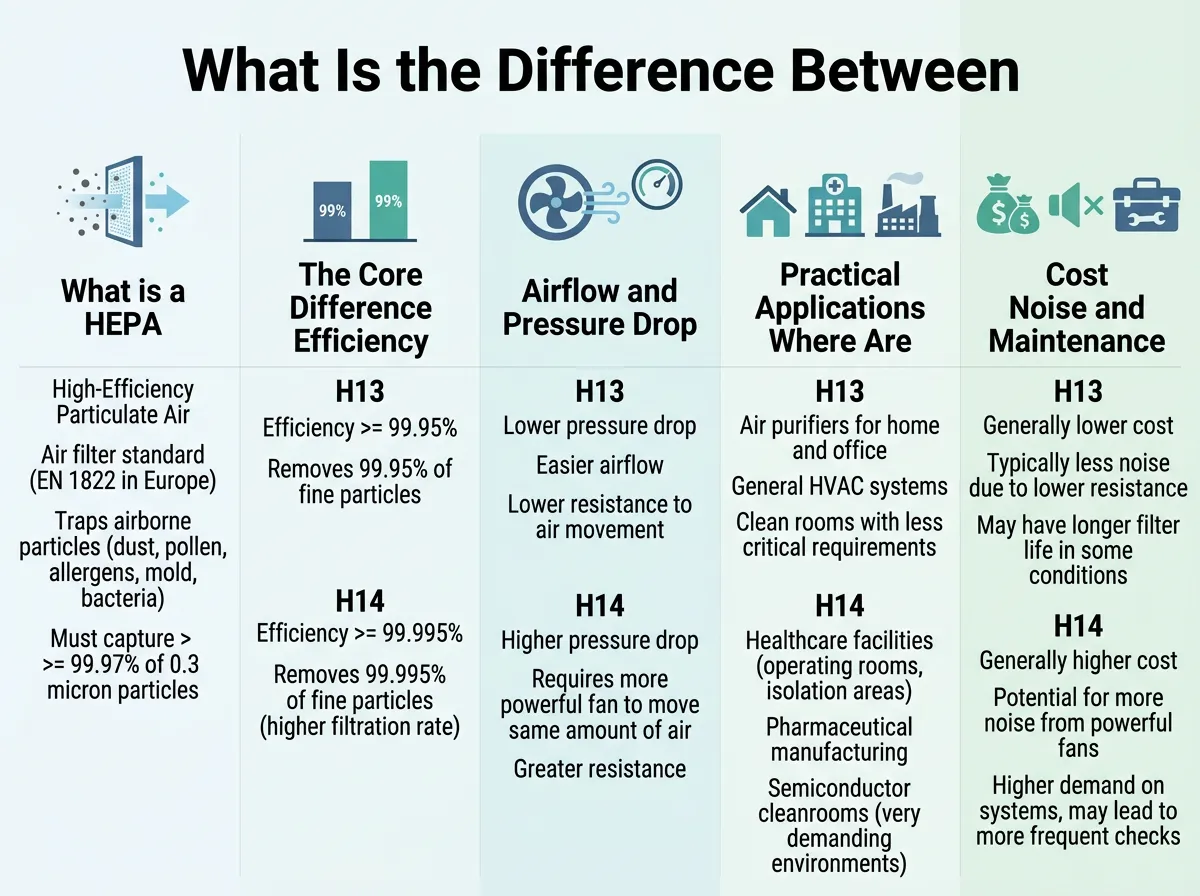
What Is the Difference Between H13 and H14 HEPA Filters? — key points at a glance
H13 HEPA Filters
An H13 filter has a filtration efficiency rating of 99.95%. This means it stops 99.95% of all particles down to 0.3 microns in size. Think of it this way: out of 10,000 tiny particles floating in the air, only 5 will get past an H13 filter. The other 9,995 particles are trapped forever. This is why H13 is considered a medical-grade filter. It is highly effective at cleaning the air we breathe every day.
H14 HEPA Filters
An H14 filter is even stronger. It has an efficiency rating of 99.995%. This means it traps 99.995% of all particles down to 0.3 microns. Out of 100,000 tiny particles, only 5 can escape. If you compare the difference between H13 and H14 filtration systems, this small mathematical gap is the key. While the difference of 0.045% sounds tiny, it is very important in highly sterile environments.
Airflow and Pressure Drop
You might think that higher efficiency is always better. Why not just buy an H14 filter for every room? The reason lies in physics and how air moves through a filter. To make a filter more efficient, you must pack the glass fibers closer together. This creates a denser barrier.
What Is Pressure Drop?
When fibers are packed tightly, they resist the flow of air. This resistance is called “pressure drop.” Think of drinking liquid through a straw. A wide straw is easy to use. A thin, narrow straw takes a lot of effort to drink through. An H14 filter is like that thin straw. It requires much more force to push air through its dense fibers compared to an H13 filter.
Why Fan Power Matters
Because H14 filters resist air, they need a very strong fan motor to push air through. If you put an H14 filter into a standard home air purifier, the fan might struggle. The overall airflow will drop. If the airflow drops, the machine cannot clean the air in your room as quickly. It can also cause the motor to overheat and wear out. This is a crucial point when considering what is the difference between H13 and H14 HEPA filters for daily use.
Practical Applications: Where Are They Used?
Because of these differences in efficiency and airflow, H13 and H14 filters serve very different purposes. They are built for different environments.
Where to Use H13 HEPA Filters
For almost all homes, offices, and schools, H13 is the perfect choice. It easily removes common household allergens. This includes pet hair, dust mites, mold spores, and pollen. It is also excellent for removing smoke from cooking or outdoor wildfires. When looking at choosing between H13 and H14 for your home, H13 is almost always the smart choice. It gives you medical-grade protection without slowing down your air purifier.
Where to Use H14 HEPA Filters
H14 filters are designed for environments where even a tiny speck of dust can cause major problems. You will find them in hospital operating rooms, burn units, and isolation wards. They are also used in factories that build computer chips or manufacture delicate electronics. In these spaces, the air must be completely sterile. The high cost of running H14 filters is worth it to keep these areas clean.
Cost, Noise, and Maintenance
Before making a purchase, you should consider the long-term costs of running an air purifier. There are big differences here that can affect your wallet.
Filter and Machine Costs
Because H14 filters are harder to make, they are much more expensive to buy. The machines that run them also cost more. They need heavy-duty motors and strong fans. On the other hand, H13 filters are widely produced. You can easily find affordable replacement filters for your H13 air purifier.
Noise Levels
Do you like a quiet bedroom? A stronger fan motor makes more noise. Since H14 filters require more pressure, the machines running them tend to be louder. An H13 air purifier can run on a lower, quieter setting while still cleaning your air effectively. If you want a peaceful night of sleep, an H13 unit is much better.
Energy Consumption
A stronger fan motor uses more electricity. If you run your air purifier all day, an H14 unit will increase your power bill. An H13 unit runs efficiently and uses very little power. This makes H13 better for your wallet and the environment. Learning about the different types of HEPA filters and how they impact energy use can save you money over time.
How to Choose the Right Filter for You
Are you still trying to decide which filter is best for your home? Here is a quick guide to help you choose.
Assess Your Health Needs
If you or your family members have mild asthma, seasonal allergies, or pets, an H13 filter is fantastic. It will keep your air fresh and clean. If you have an extremely weak immune system or severe medical conditions, you might consider an H14 unit. However, you must make sure the machine is specifically designed to handle an H14 filter.
Consider Room Size and CADR
CADR stands for Clean Air Delivery Rate. It measures how fast a unit cleans a room. Because H13 filters allow better airflow, they often have a higher CADR than H14 units of the same size. If you have a large living room, an H13 unit will actually clean the air faster. It will circulate the air more times per hour.
Check the Total Cost of Ownership
Do not just look at the price of the air purifier today. Look at how much replacement filters cost. You will need to change your filter every 6 to 12 months. Make sure you are comfortable with the ongoing cost of replacements before you buy.
Conclusion
When looking at what is the difference between H13 and H14 HEPA filters, the answer comes down to your personal goals. H14 filters offer the highest level of clean possible. However, they come with higher costs, louder fans, and lower airflow. H13 filters offer medical-grade cleaning that is perfect for daily life. They keep your home safe from dust, smoke, and allergens without the extra noise and cost. For a happy, healthy home, H13 is the clear winner.
Frequently Asked Questions
What is the difference between H13 and H14 HEPA filters?
The main difference is their filtration efficiency. H13 filters trap 99.95% of particles down to 0.3 microns, while H14 filters trap 99.995% of those same particles. H14 filters are denser and require much stronger fans to push air through.
Are H13 and H14 filters considered medical-grade?
Yes, both H13 and H14 are classified as medical-grade HEPA filters. They far exceed standard true HEPA filters and are used in professional and medical settings to capture bacteria and viruses.
Can I put an H14 filter into an H13 air purifier?
It is not recommended to swap them unless the manufacturer says you can. Because H14 filters are denser, your H13 air purifier fan may not be strong enough to push air through it, which can damage the motor.
Is H14 better than H13 for home use?
For almost all homes, H13 is actually the better choice. It offers excellent allergen removal while maintaining high airflow and quiet operation. H14 filters are too restrictive and expensive for normal household needs.
Do H13 filters block viruses?
Yes, H13 filters are highly effective at trapping viruses, bacteria, and mold spores. They capture 99.95% of particles at the 0.3-micron size, which is where most airborne germs reside.
How often do I need to replace H13 and H14 filters?
Most H13 and H14 filters should be replaced every 6 to 12 months, depending on how often you run the machine and the air quality in your area. Always check your manufacturer’s guide for specific instructions.
